Book a Workshop
Category

Taxes

Home / Taxes
Business, Financial Planning, Taxes

Getting Money Out of Your Corporation

As a business owner, you may have surplus cash building up inside your corporation, but what is the most tax-efficient way of withdrawing funds? It is important to plan ahead so that you can decide what works best for your situation and keep more of what you earn.

Here are 5 ways to withdraw money from your business in a tax-efficient manner.

1. Salary vs. Dividends
Business owners often use a mix of salary and dividends to take income from their businesses. Deciding on the right balance requires understanding how each affect both corporate and personal taxes.

If you pay yourself a salary, it is tax-deductible from your corporation and reduces your taxable corporate income. However, your salary will be taxed based on your individual marginal tax rate.

Dividends allow you to draw profits without the payroll obligations that come with a salary. While they can be more tax-efficient, they do not create Registered Retirement Savings Plan (RRSP) contribution room or allow for certain tax deductions tied to a salaried income, such as childcare expenses.

2. Capital Dividend Account (CDA)
The CDA allows your corporation to pay out certain amounts to Canadian resident shareholders as a tax-free dividend. Be aware of the legal rules or consult with an accountant to determine what qualifies for the CDA and how withdrawals must be properly documented.

3. Whole Life Insurance
Whole life insurance can act as a tax-sheltered way to grow your wealth inside your corporation. Over time, this can create a source of tax-free withdrawals for your shareholders or beneficiaries, as it can boost your CDA balance.

4. Refundable Dividend Tax on Hand (RDTOH)
If your corporation earns passive investment income, you will likely pay additional tax. These amounts accumulate in an RDTOH account, and part of the tax is refunded to the corporation when you pay yourself dividends

5. Shareholder Loan Repayments
Consider moving other assets of value into your corporation for investment purposes. This may include investment real estate or collectibles. When you transfer your investment assets into your corporation, you create future opportunities for tax-free withdrawals via shareholder loan repayments.

Understanding the most tax-efficient ways to withdraw money from your business is an essential part of navigating the complexities of being a business owner. Most of the time, there is not one single strategy that works for all business owners. Your approach will depend on your priorities, income needs, long-term plans, and how your corporation is structured.

Planning ahead can help you keep more of what you have earned. If you would like to explore which strategies work for your situation, we encourage you to check in with your financial advisor and tax planner.


Frequently Asked Questions

We reached out to Jason Ding CPA, Co-founder of Notion CPA, who shared his insights on tax planning considerations.

1. Can I combine different strategies to be more tax-efficient?

Yes, absolutely. Generally, there should be a pragmatic approach when taking money out of your corporation. A review of both your corporate and personal situation should be considered.

2. Are there tax-free ways to withdraw money from my corporation?

Most of the time, money taken out of a corporation, like salary or dividends, is taxable. One exception can be a shareholder loan. In certain situations, you can borrow from your corporation without paying tax immediately.

However, a shareholder loan can be quite complicated. Factors including interest rates, what the money is used for, and how your company normally handles loans, all affect whether the money stays tax-free

3. What mistakes do business owners make when withdrawing money, and how can I avoid them?

The most common mistakes we see are:
 
  • Not taking any dividends or payroll when shareholders don’t need money from their corporation.
  • Increasing salary or dividends to cover higher personal costs (e.g. bigger home, rising interest rates) without stepping back to see if a short-term loan would be more appropriate.
  • Taking out extra salary just to maximize RRSP contributions, even though RRSPs are often not the most effective option for business owners.
Withdrawal strategies can be complex, so it is important to get professional advice from your accountant before making decisions.


Connect with Notion CPA

notioncpa.com

[email protected]

Clients, Families, Financial Planning, Taxes

2025 Summer Financial Checklist

The sun is out, and for many, summer brings a shift in pace with some time to rest, reflect, and reprioritize. Whether you’re spending time with friends and family, traveling, or navigating the school break, we often forget to take time to review our financial plan.

Now is an ideal time to do a mid-year review of your finances and reassess your priorities. Intentional planning goes a long way in preparing for the unpredictable. We’ve updated our summer checklist to help you stay organized and keep your financial goals on track.

Investment Contributions

  • RESP – While there is no annual RESP contribution limit, we recommend that you contribute up to $2,500 per beneficiary per year to maximize the grant. Be mindful that the lifetime contribution limit per beneficiary is $50,000.
  • RDSP – You may be eligible for up to $3,500 in matching grants depending on your income and contributions.
  • TFSA – This year’s additional contribution room is $7,000. Remember to check for any unused contribution room from past years.
  • FHSA – The additional contribution room this year is $8,000. Remember that you will only start accumulating room in the year that you open the account. Unused contribution room can be carried forward, but the maximum carry forward amount is $8,000.

Cybersecurity Tip: Take a moment to review the passwords on your investment and insurance accounts. Many companies now use multi-factor authentication to add an extra layer of protection for your information.

Legal and Accounting

  • *Updated* Capital Gains Tax – On March 21, 2025, the Government of Canada cancelled the planned capital gains increase. Capital gains up to $250,000 will remain taxed at 50% for individuals.
  • Corporate Taxes – Many corporations have a fiscal year-end in the summer. Now is a good time to prepare your tax documents and get them ready for your accountant.
  • Wills – Make sure your will is up to date. If you do not have one yet, we recommend consulting a lawyer to create one. Alternatively, you can use online services like willful.co to set one up.
    Bookkeeping – Get your bookkeeping up to date now to avoid the rush later in the year.

Travel

  • Insurance – Remember to have travel insurance before your vacation to protect your family from unexpected and costly medical expenses. Be sure to review your coverage details before your trip so you are well prepared in case of an emergency.
  • Spending Plan – Create a spending plan ahead of time to avoid overspending while on vacation.
  • Foreign Fees – Consider using a credit card without foreign fee transactions to save up to 2.5% per transaction.

With your finances in order, you can enjoy summer with confidence. Remember, while we may not be able to predict what lies ahead this season and beyond, we can prepare for it.

If you have any questions or would like to review your financial plan, we encourage you to check in with your financial advisor.

Clients, Families, Financial Planning, Taxes

2024 Summer Financial Checklist

Photo by Natalya Zaritskaya on Unsplash

With the school year wrapping up, many transitions are underway. Children are starting their summer break, and families are planning trips, from beach visits to longer holidays abroad. Recent medical school graduates are also stepping into their new roles as residents.

No matter your situation, our team at FLC has updated our summer checklist to help you manage your finances during these changes. As always, feel free to reach out to your advisor if you have any questions or want to discuss any of these items further.

Investment Top-Ups

  • RESP – You can contribute up to $2,500 per child this year to maximize the grant. If you have missed contributions in past years, you can contribute up to an additional $2,500 as a catch-up.
  • RDSP – Depending on your family’s income, you can contribute $1,000-$1,500 to maximize the grant. For more information, click here.
  • TFSA – This year’s additional contribution room is $7,000. Remember to check for any unused contribution room from past years too!
  • FHSA – This is a helpful way to save for your first home and reduce your taxes for the year. You have $8,000 of additional room this year. Remember that you will only start accumulating room in the year that you open the account.

Cybersecurity Tip: review your existing passwords for your investment and insurance accounts. Many companies are moving towards multi-factor authentication to help keep your information secure.

Photo by Sandy Ravaloniaina on Unsplash

Legal and Accounting

  • *New* Capital Gains Tax – On June 25th, this capital gains inclusion rate will increase to 66.7%. This will apply to amounts exceeding $250,000 for individuals and on the first dollar for corporations. Be sure to review your investments with your advisor to determine if any actions should be taken ahead of the change.
  • Corporate Taxes – Many corporations have a year-end during the summer. Start preparing your tax package to submit to your accountant and check this off your to-do list!
  • Wills – Ensure your will is up to date. If you do not have one, we recommend working with a lawyer to create one. At the very least, you can easily create one online at willful.co so that you have something in place. Talk to us to find out if you qualify for a discount.
  • Bookkeeping – get your bookkeeping back on track and avoid having to do it during the busier holiday season.

Photo by Khachik Simonian on Unsplash

Travel

  • Insurance – Remember to ensure you have travel insurance before leaving for your vacation to protect your family from unexpected and costly medical expenses.
  • Inspect what you Expect – Review your travel insurance coverage details before your trip so that you are better prepared in the event of an emergency. Knowing the number to call and the nearest approved hospital is especially helpful when time is of the essence.
  • Spending Plan – Consider using a credit card without foreign fee transactions to save up to 2.5% per transaction.

Photo by Andrew Ruiz on Unsplash

Last, but not least…

Remember to schedule a check-in with your financial advisor. Enjoy the summer and we will meet-up with you in the fall!


The comments contained herein are a general discussion of certain issues intended as general information only and should not be relied upon as tax or legal advice. Please obtain independent professional advice, in the context of your particular circumstances. This article was written, designed and produced by Financial Literacy Counsel, a registered trade name with Investia Financial Services Inc., and does not necessarily reflect the opinion of Investia Financial Services Inc. The information contained in this article comes from sources we believe reliable, but we cannot guarantee its accuracy or reliability. The opinions expressed are based on an analysis and interpretation dating from the date of publication and are subject to change without notice. Furthermore, they do not constitute an offer or solicitation to buy or sell any securities.

Mutual Funds are offered through Investia Financial Services Inc. Commissions, trailing commissions, management fees and expenses all may be associated with mutual fund investments.  Please read the prospectus before investing. Mutual funds are not guaranteed, their values change frequently, and past performance may not be repeated.

Taxes

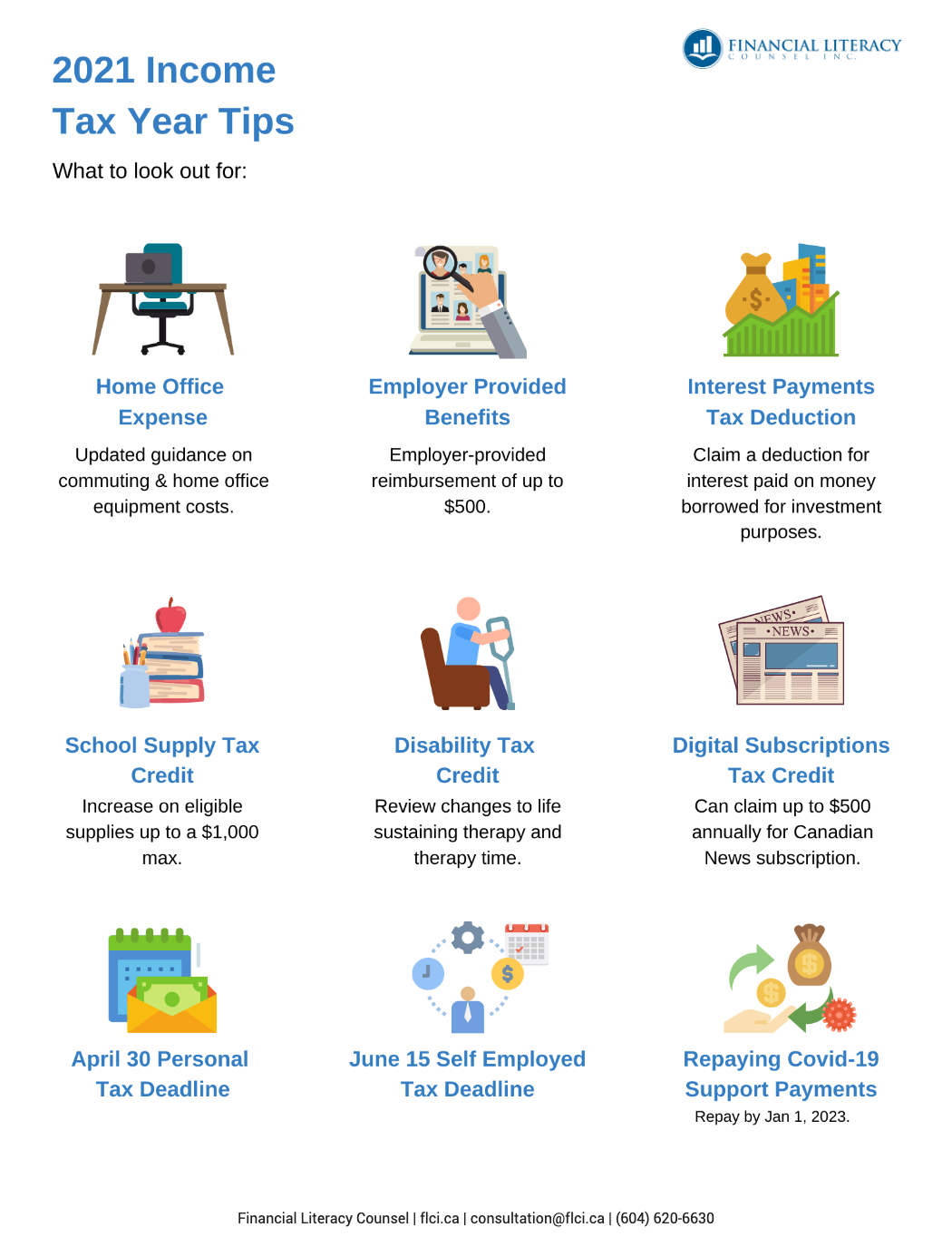
Tips for Filing Your 2021 Tax Return

Tax Tips You Need to Know Before Filing Your 2021 Taxes

This year’s tax deadline is April 30, 2022. We’ve got a list of tips to help you save on your taxes!

Claiming home office expenses

You can claim up to $500 under the “flat rate” method if you worked at home due to COVID-19. To claim more, you must use the detailed method to claim home office expenses.

Employer-provided benefits

The CRA will generally not consider employer-provided benefits taxable if your employer reimburses you for certain costs (such as commuting costs, parking, and home office equipment) due to COVID-19.

Repaying COVID-19 support payments

If you repaid COVID-19 benefits, you can deduct the amount on your tax return either for the year you received the benefit or the year you repaid it, or you can split the deduction between both years.

Climate Action Incentives can no longer be claimed

As of 2021, Climate Action Incentives can’t be claimed as a refundable credit; instead, you’ll receive quarterly payments via the benefits system.

Disability tax credit (DTC)

If you or a family member are DTC claimants, then you should review the updated criteria for the tax credit in regards to mental functions, life-sustaining therapy and calculating therapy time.

Eligible educator school supply tax credit

This tax credit has been increased to 25% for eligible supplies (such as books and games) to a maximum of $1,000.

Tax deduction on interest payments

You can claim a tax deduction for the interest you’ve paid on any money you have borrowed to invest. However, you can only do this if you use the money to earn investment income (for example, a rental property).

The digital subscriptions tax credit

You can claim up to $500 as a tax credit if you have a digital subscription to a qualifying Canadian news outlet.

Self-employed? Be sure to set aside enough for personal income tax!

If you’re self-employed, be sure you put aside enough money (we recommend at least 25% of your income) to pay your tax bill when the time comes. You’re taxed only on your net income (total income minus expenses).

You need to plan ahead for tax changes if you want to retire abroad

Planning to retire abroad? If so, you need to be aware of the tax implications and plan accordingly. If you sell your house and move, you may be considered a “non-resident” and be subject to capital gains taxes on non-registered investments (even if you have not sold them) or have your pension subjected to a withholding tax.

You can stop making CPP contributions if you’re over 65 but plan to keep working

If you’re 65 and already collecting Canada Pension Plan (CPP) benefits but also still working, you may be able to stop making CPP contributions. To do so, you need to fill in the form CPT30.

Need help?

Not sure if you qualify for a credit or deduction? Reach out to your advisor at FLC to discuss how to save money on this year’s tax return.

Families, Taxes

2021 Personal Year-End Tax Tips

The end of 2021 is quickly approaching – which means it is time to get your finances in order, so you are prepared when it comes time to file your taxes.

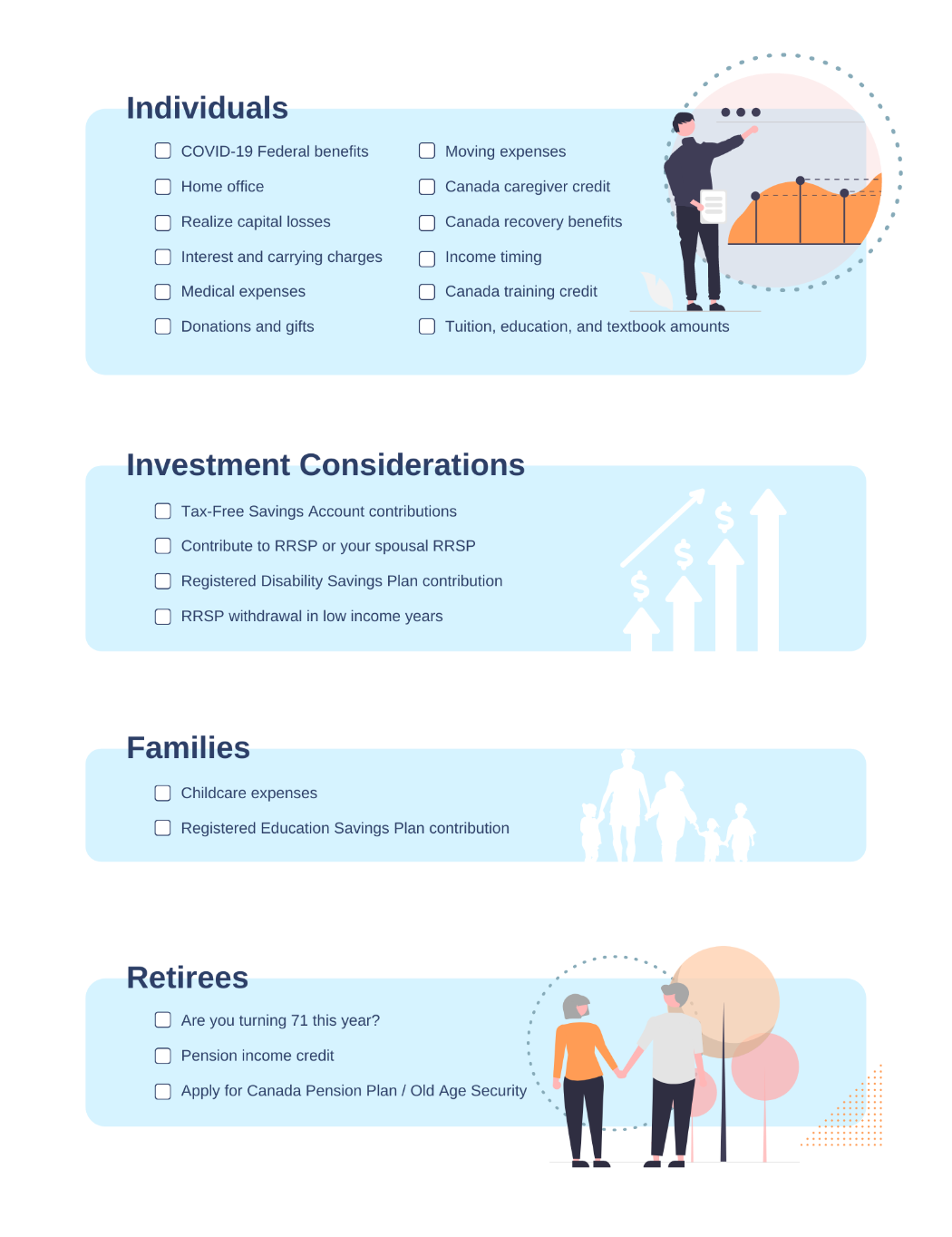
In this article, we cover four types of personal tax tips:

  • Individuals

  • Investment Considerations

  • Families

  • Retirees

If you’re looking for tax tips for business owners, see our previous article.

Individuals

Tax planning is an essential part of integrated financial planning. We want to help ensure you are only paying the necessary taxes based on your income and financial activities.

Individuals affected by COVID-19 may be able to apply for the following benefits:

  • You can apply for the Canada Recovery Benefit if you are not eligible for Employment Insurance (EI), and have had your income reduced or cannot work due to COVID-19. This benefit ended as of October 23, 2021, but you can still claim the last eligible period until December 22, 2021.

  • You can apply for the Canada Recovery Sickness Benefit if you are sick or need to self-isolate due to COVID-19. This benefit is scheduled to end on November 21, 2021, but legislation has been proposed to extend it to next May.

  • You can apply for the Canada Recovery Caregiving Benefit if you cannot work because you need to supervise a child or other dependent family member because they are ill with COVID-19 or their usual school or other facility is closed. This benefit is scheduled to end on November 21, 2021, but legislation has been proposed to extend this benefit to next May.

  • A new proposed Canada Worker Lockdown Benefit would provide $300 a week if you cannot work due to a government-imposed lockdown (and are not receiving EI). Legislation for this benefit has not yet passed.

You must apply for these benefits no later than 60 days after the end of the claim period. You will receive a T4A from the CRA and must report any money received from these benefits as income on your 2021 tax return.

All Canada Recovery Benefits (CRB) are subject to a 10% withholding tax. If you earned over $38,000 in net income in 2021, you might be required to reimburse the government some or all of the CRB at tax time. You can use tax deductions such as RRSP contributions to avoid either additional tax on these recovery benefits or reduced benefits.

If you have to repay any COVID-19 benefits, you can deduct the repayment amount from your income in the year you received the benefit.

For 2020, the CRA introduced a simplified process for claiming a deduction for home office expenses for employees working from home due to COVID-19. An employee can either claim using a new temporary flat rate method or use the more traditional method for claiming home office expenses. We assume a similar approach will be allowed for 2021, so be sure to track all your home office expenses.

Do you expect to have any capital losses? If you have capital losses, you must first deduct them against any capital gains you had in the current year. After that, you can carry back any excess capital losses up to three years or forward indefinitely. Trades can take up to two days to settle, so be sure to sell any investments you want to claim a capital loss on by December 29 at the latest.

You can deduct any fees you pay to manage or administer your non‑registered investments. As well, you can usually deduct interest charges paid on borrowed money if you used the money to earn income from non‑registered investments or a business. If you have non-deductible interest, like a mortgage or car loan, talk to your tax advisor to see if you can restructure your investments to make the interest on these loans tax‑deductible.

If you have eligible medical expenses that were not paid for by either a provincial or private plan, you can claim these expenses against your taxes. You can even deduct premiums you pay for private coverage. Either spouse can claim qualified medical expenses for themselves and dependent children in a 12-month period. It is generally better for the spouse with a lower income to claim the expense because the credit is reduced by a percentage of net income. However, if the lower-income spouse does not have enough tax payable to offset the medical expense tax credit, it may be beneficial to move the expenses to the higher-income spouse.

Tax credits for donations are two-tiered, with a larger credit being available for donations over $200. You and your spouse can pool your donation receipts and carry donations forward for up to five years. If you donate items like stocks or mutual funds directly to a charity, you will be eligible for a tax receipt for the fair market value and the capital gains tax does not apply.

If you have moved to be closer to school or a place of work, you may be able to deduct moving expenses against eligible income. You must have moved a minimum of 40 km.

If you care for a dependant relative with a mental or physical impairment, you may be able to claim a non-refundable tax credit.

Will your personal tax rate be lower in 2022 than it will be for 2021? If so, and you have the option, you may wish to defer receiving income to 2022. And if your tax rate will be higher in 2022 than for 2021, try to accelerate income and receive it before the end of 2021.

There are a few options available to you when it comes to tax credits and deductions if you are enrolled in school:

  • If you are between the ages of 25 to 65 and enrolled in an eligible educational institution, you can claim a federal tax credit of $250 for 2021.

  • You can claim tuition paid on your taxes, carry the amount forward, or transfer an unused tuition amount to a spouse, parent, or grandparent.

Investment Considerations

Depending on your circumstances, there are up to three different ways you can set aside money in registered accounts to save for the future:

  1. Contribute to your Tax-Free Savings Account (TFSA). You can contribute up to a maximum of $6000 for 2021. You can carry forward unused contribution room indefinitely. For instance, if you have never contributed to your TFSA, the cumulative total from 2009 to 2021 is $75,500.

  2. Contribute to your Registered Retirement Savings Plan (RRSP) or a spousal RRSP. Remember, you can deduct contributions made in the year or within the first 60 days of the following calendar year from your 2021 income. You also have the option of carrying forward deductions.

  3. Suppose you have a Registered Disability Savings Plan (RDSP) open for yourself or an eligible family member. You may be able to have both the Canada Disability Savings Grant (CDSG) and the Canada Disability Savings Bond (CDSB) paid into the RDSP. The CDSB is based on the beneficiary’s adjusted family net income and does not require any contributions to be made. The CDSG is based on both the beneficiary’s family net income and contribution amounts. In addition, up to 10 years of unused grants and bond entitlements can be carried forward.

If you need extra money this year because your income was unusually low, you may want to consider making an RRSP withdrawal before the end of the year to boost your income. This is generally only a good idea if you are in the lowest tax bracket. Be aware that you will permanently lose that contribution room if you withdraw money from an RRSP. However, if you are concerned about whether making an RRSP withdrawal is a good strategy for you, we are happy to answer any questions you may have.

Families

If you paid someone to take care of your child so you or your spouse could attend school or work, then you can deduct these expenses. Various childcare expenses qualify for this deduction, including boarding school, camp, daycare, and even paying a relative over 18 for babysitting.

Be sure to get all your receipts and have the spouse with the lower net income claim the childcare expenses. Some provinces offer additional childcare tax credits on top of the federal ones.

A Registered Education Savings Plan (RESP) can be a great way to save for a child’s future education. However, the Canadian Education Savings Grant (CESG) is only available on the first $2,500 of contributions you make each year per child (to a maximum of $500, with a lifetime maximum of $7,200.).

If you have any unused CESG amounts for the current year, you can carry them forward. If the recipient of the RESP is now 16 or 17, they can only receive the CESG if:

a) At least $2,000 has already been contributed to the RESP; and
b) A minimum contribution of $100 was made to the RESP in any of the four previous years.

Retirees

Are you turning 71 this year? If so, you are required to end your RRSP by December 31. You have several choices on what to do with your RRSP, including transferring your RRSP to a Registered Retirement Income Fund (RRIF), cashing out your RSSP, or purchasing an annuity. Talk to us about the tax implications of each of these choices.

Are you 65 or older and receiving pension income? If your pension income is eligible, you can deduct a federal tax credit equal to 15% on the first $2,000 of pension income received – plus any provincial tax credits.

If you don’t currently have any pension income, you may want to think about withdrawing $2,000 from an RRIF each year or using RRSP funds to purchase an annuity that pays at least $2,000 per year.

If you have reached the age of 60, you may be considering applying for the Canada Pension Plan (CPP). However, keep in mind that the monthly amount you will receive will be lower if you apply at 60 versus a later age. Keep in mind, you do not have to be retired to apply for CPP.

If you are 65 or older, ensure that you are enrolled for Old Age Security (OAS) benefits. Retroactive OAS payments are only available for up to 11 months plus the month you apply. If you are running into OAS “clawback” issues, consider ways to split or reduce other sources of income to avoid this.

Need some additional guidance?

We hope you have enjoyed all of our tax tips. If you have questions or want help to make sure you optimize your financial and tax planning, reach out to us and set up a time to talk.

If you own a business, check out our 2021 year-end tax tips for business owners.

Business, Financial Planning, Taxes

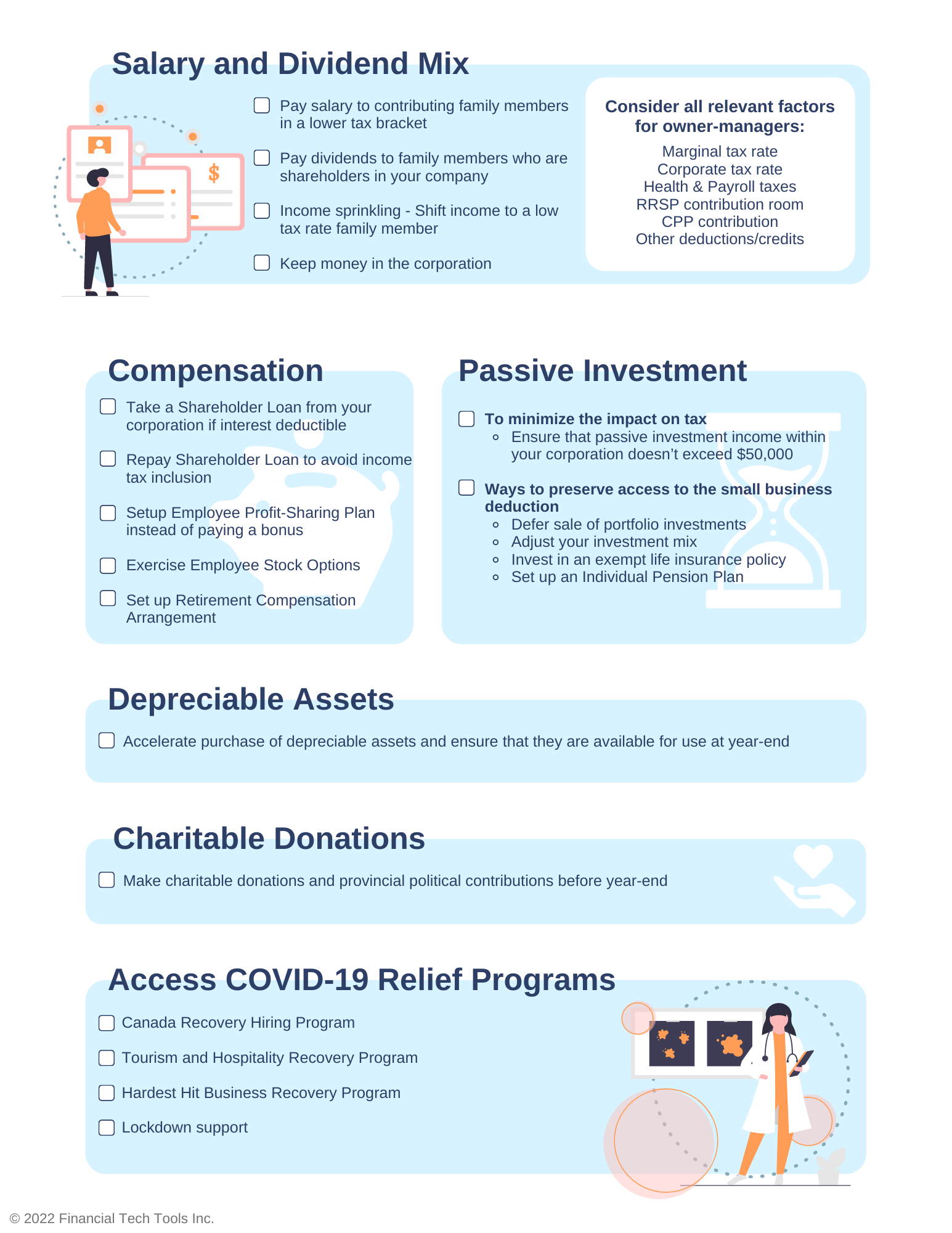
2021 Year-End Tax Tips for Business Owners

As we approach the end of the year, it’s time to review your business finances. Here are six business tax-planning strategies you need to know!

1. Salary and Dividend Mix

As a business owner, one essential part of tax planning is determining the right mix of salary and dividends for both yourself and your family members.

The following are key considerations when determining how to distribute money from your corporation:

  • Pay a salary to family members who work for your business and are in a lower tax bracket. This enables them to declare income, contribute to the Canada Pension Plan (CPP) and create contribution room towards their Registered Retirement Savings Plan (RRSP).  You must be able to prove the family members have provided services in line with the compensation allotted.
  • Pay dividends to family members who are shareholders in your company.  Depending on the province or territory of residence, the amount of dividends one can receive without incurring income tax will vary.
  • Distribute money from your corporation via income sprinkling.  Income sprinkling shifts income from a high tax-rate individual to an individual with a low or nil personal tax rate.  However, this strategy can cause issues due to Tax on Split Income (TOSI) rules. A tax professional can help you determine the best way to “income sprinkle” so none of your family members are subject to TOSI.
  • Keep money in the corporation if neither you nor your family members need cash. If your company qualifies as a Canadian-Controlled Private Corporation claiming the small business deduction, your corporation can defer the taxes by retaining the income.

No matter which strategy you choose to distribute money from your corporation, keep the following in mind:

  • Your marginal tax rate as the owner-manager
  • The corporation’s tax rate
  • Your RRSP contribution room
  • Your current health condition
  • The impact of payroll taxes
  • The effects of the chosen strategy on CPP contributions
  • Other eligible deductions and credits (e.g., charitable donations, childcare, or medical expenses)


2. Compensation

An essential part of year-end tax planning is determining appropriate compensation methods. The following are the main things to consider:

  • Can you benefit from a shareholder loan? A shareholder loan is an agreement to borrow funds from your corporation for a specific purpose.  The interest from the loan might be deductible if the proceeds of the shareholder loan are used to produce income from business or property.
  • Do you need to repay a shareholder loan to avoid paying personal income tax on your borrowed amount?
  • Is setting up an employee profit-sharing plan a better way to disburse business profits than simply paying out a bonus?
  • Keep in mind that when an employee cashes out stock options, only one party (the employee OR the employer) can claim the tax deduction.
  • Think about setting up a Retirement Compensation Arrangement (RCA) to help fund you or your employees’ retirement.


3. Passive Investments

One of the most common tax advantages available to Canadian-Controlled Private Corporations (CCPC) is the Small Business Deduction (SBD).  For qualifying businesses, the SBD reduces your corporate tax rate.

However, if your corporation earns passive investment income, the SBD decreases by five dollars for every dollar of passive investment income over $50,000 your CCPC earned the previous year. The best way to avoid losing a portion or all of the SBD is to ensure that the passive investment income within your associated corporation group does not exceed $50,000.

To preserve your access to the SBD, consider the following:

  • Defer the sale of portfolio investments as necessary.
  • Adjust your investment mix to be more tax efficient. For example, you could choose to hold more equity investments than fixed-income investments. Only 50% of the gains realized on shares sold is taxable, but investment income earned on bonds is fully taxable.
  • Invest excess funds in an exempt life insurance policy. Any investment income earned on this policy is not included in your passive investment income total.
  • Set up an Individual Pension Plan (IPP). An IPP is like a defined benefit pension plan and is not subject to the passive investment income rules.


4. Depreciable Assets

Another strategy to consider for year-end tax planning is accelerating your purchase of any depreciable assets.  A depreciable asset is a type of capital property eligible for the Capital Cost Allowance (CCA) tax deduction.

Here are two ways to make the most of tax planning with depreciable assets:

  1. Make use of the Accelerated Investment Incentive.  Some depreciable assets are eligible for an enhanced first-year allowance with this incentive.
  2. Purchase equipment such as zero-emissions vehicles and clean energy equipment eligible for a 100% tax write-off.


5. Donations

Another essential part of tax planning is to make all your donations before the end of the year—both charitable donations and political contributions.

For charitable donations, you need to consider the best way to make your donations and the different tax advantages of each type. For example, you can:

  • Donate securities
  • Give a direct cash gift to a registered charity
  • Use a donor-advised fund account at a public foundation—a donor-advised fund is like a charitable investment account
  • Set up a private foundation to solely represent your interests

Reach out to your Financial Planner and Accountant to confirm the tax implications of each type of charitable donation.


6. Make the Most of COVID-19 Relief Programs

While some COVID-19 relief programs have ended such as Canada Emergency Wage Subsidy (CEWS) and Canada Emergency Rent Subsidy (CERS), others are still available.

Determine if your business can benefit from any of the following relief programs:

  • Canada Recovery Hiring Program (CRHP).  This program will continue to run until May 2022.  If your business continues to experience a decline in revenue compared to pre-pandemic levels, CRHP will provide support to assist in hiring new staff or increase the wages of your existing staff.
  • Tourism and Hospitality Recovery Program (THRP). This new program provides wage and rent support to businesses in the tourism and hospitality industry such as hotels and restaurants. Eligible businesses must have an average monthly revenue reduction of at least 40% over the first 13 qualifying periods for the CEWS, and a current-month revenue loss of at least 40%.
  • Hardest Hit Business Recovery Program (HBRP). The HBRP provides rent and wage support of up to 50% for eligible businesses. They must meet two conditions: an average monthly revenue reduction of at least 50% over the first 13 qualifying periods for the CEWS, and a current-month revenue loss of at least 50%.
  • Lockdown Support. If there is a public health lockdown causing sufficient revenue loss, your business would be eligible for support at the same subsidy rates as the THRP.

Pay attention to which benefits are considered taxable income. If you received assistance from government assistance programs including the CEWS, CERS, and CRHP; this assistance is taxable as income.


Get year-end tax planning help from someone you trust!

We’re here to help you with your year-end tax planning. Book an appointment to learn how you can benefit from these tax tips and strategies.

Financial Planning, Taxes

TFSA vs RRSP – What you need to know to make the most of them in 2021

TFSAs and RRSPs can provide significant tax savings if you are seeking ways to save in a tax-efficient manner. To help you understand the difference between the two, we compare:

  1. TFSA versus RRSP – Differences in deposits
  2. TFSA versus RRSP – Differences in withdrawals

1) TFSA versus RRSP – Differences in deposits

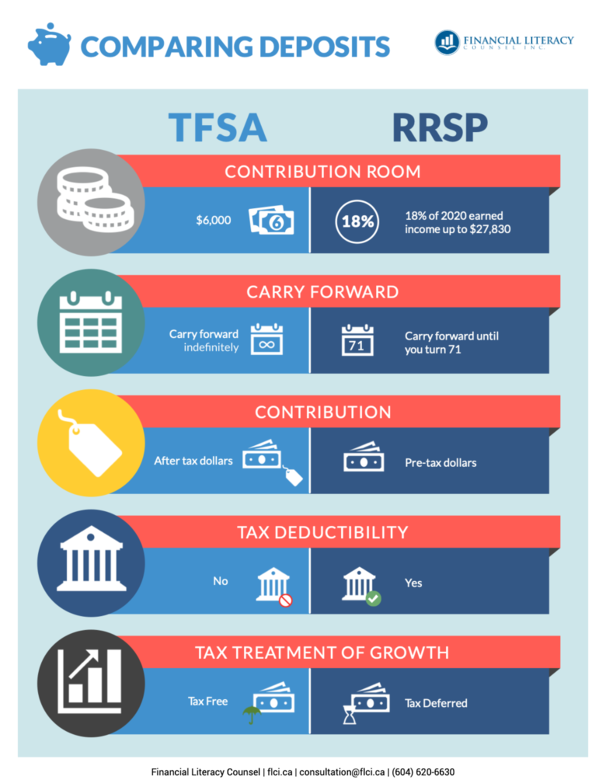
There are several areas to look at when comparing differences in deposits for TFSAs and RRSPs in 2021:

  • Contribution Room
  • Carry Forward
  • Contribution and Tax Deductibility
  • Tax Treatment of Growth

How much contribution room do I have?

If you have never contributed to a TFSA before, you can contribute up to $75,500, today. This table outlines the contribution amount you are allowed each year, from the time TFSAs were created, to now:

For RRSPs, the deduction limit is always 18% of your previous year’s pre-tax earnings, to a maximum of $27,830. For example, if you earned $60,000 in 2020, then your deduction limit for 2021 would be $10,800 (18% x $60,000). If you earned $200,000, your deduction limit would be capped at the maximum of $27,830.

How much contribution room can I carry forward?

If you choose not to contribute to your TFSA one year or do not contribute the maximum amount in a year, you can indefinitely carry forward your unused contribution room. The only restrictions on this are: 1) you must be a Canadian resident, 2) be older than 18, and 3) have a valid social insurance number. If you make a withdrawal, the amount you withdrew is added on top of your annual contribution room for the next calendar year.

For an RRSP, you can carry forward your unused contribution room until the age of 71. When you turn 71, you must convert your RRSP into an RRIF. If you make a withdrawal from your RRSP, you do not need to open any additional contribution room.

Contributions and Tax Deductibility

Your TFSA contributions are not tax-deductible and are made with after-tax dollars.

Your RRSP contributions are tax-deductible and made with pre-tax dollars.

Tax Treatment of Growth

One reason it is essential to make both RRSP and TFSA contributions, is that growth in them is treated differently.

A TFSA is more suitable for short-term objectives, like saving for a down payment for a house or a vacation, because all of the growth in a TFSA is tax-free. When you make a withdrawal from your TFSA, you do not have to pay income tax on the amount withdrawn.

The growth in an RRSP is tax-deferred. This means you will not pay any taxes on your RRSP gains until age 71, at which time, you convert RRSP into a RRIF and begin withdrawing money. RRSPs are better suited for long-term goals, like retirement. Since you have a lower income in retirement than you do when you are working, you will be in a lower tax bracket; thus, not having to pay as much tax on your RRIF income.

2) TFSA versus RRSP – Differences in withdrawals

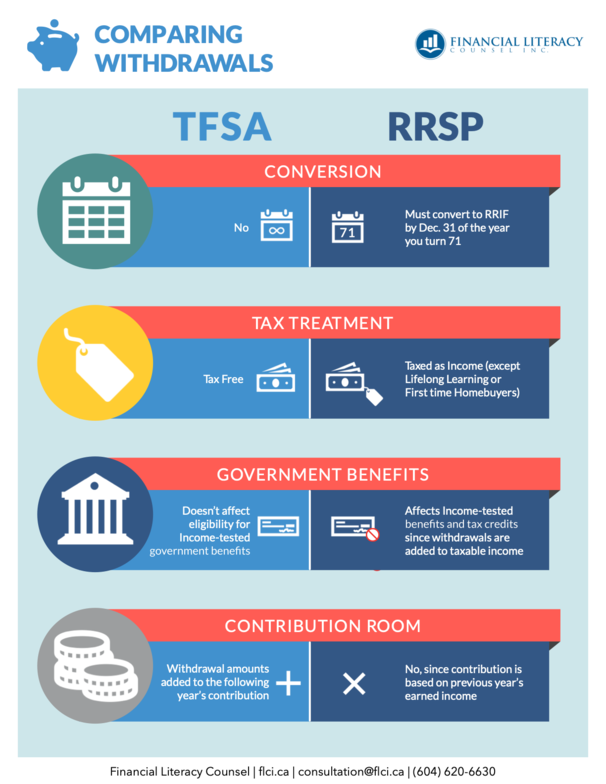
There are several areas to focus on when comparing differences in withdrawal for TFSAs and RRSPs for 2021:

  • Conversion Requirements
  • Tax Treatment
  • Government Benefits
  • Contribution Room

Conversion Requirements

For a TFSA, there are never any conversion requirements as there is no maximum age for a TFSA.

For an RRSP, you must convert it to a Registered Retirement Income Fund (RRIF) if you turn 71 by December 31st, 2021.

Tax Treatment of withdrawals

One of the most attractive things about a TFSA is that all your withdrawals are tax-free! This is why they are recommended for short-term goals; you don’t have to worry about taxes when you take money out to pay for a house or a dream vacation.

With an RRSP, if you make a withdrawal it will be taxed as income, with the exception of two cases:

  • The Home Buyers Plan lets you withdraw up to $35,000 tax-free, but you must pay it back within fifteen years.
  • The Lifelong Learning Plan lets you withdraw up to $20,000 ($10,000 maximum per year) tax-free, but you must pay it back within ten years.

How will my government benefits be impacted?

If you are making a withdrawal from your TFSA or RRSP, it is essential to know how that will affect any benefits you receive from the government.

Since TFSA withdrawals are not considered taxable income, they will not impact your eligibility for income-tested government benefits.

RRSP withdrawals are considered taxable income and can affect the following:

  • Income-tested tax credits, such as Canada Child Tax Benefit, the Working Income Tax Benefit, the Goods and Services Tax Credit, and the Age Credit.
  • Government benefits including Old Age Security, Guaranteed Income Supplement, and Employment Insurance.

How will a withdrawal impact my contribution room?

If you make a withdrawal from your TFSA, the amount you withdrew will be added on top of your annual contribution room for the next calendar year. If you make a withdrawal from your RRSP, you do not need to open any additional contribution room.

The Takeaway

RRSPs and TFSAs can both be great savings vehicles. However, there are significant differences between them, which can affect your finances. If you need help navigating these differences, please do not hesitate to contact us.

Taxes

Government of Canada to allow up to $400 for home office expenses

For the 2020 tax year, the Government of Canada has introduced a temporary flat rate method, allowing Canadians who are working from home this year to claim expenses of up to $400. Taxpayers will still be able to claim under the existing rules if they choose, using the detailed method.

Eligibility

From the canada.ca website:

Each employee working from home who meets the eligibility criteria can use the temporary flat rate method to calculate their deduction for home office expenses.

To use this method to claim the home office expenses you paid, you must meet all of the following conditions:

  • Worked from home in 2020 due to the COVID-19 pandemic
  • Worked more than 50% of the time from home for a period of at least four consecutive weeks in 2020
  • Claiming home office expenses and are not claiming any other employment expenses
  • Employer did not reimburse you for all of your home office expenses

You need to meet all of the above conditions to be eligible to use the temporary flat rate method.

New eligible expenses

For the detailed method, the CRA has expanded the list of eligible expenses that can be claimed as “work-space-in-the-home” expenses, including reasonable home internet access fees. A comprehensive list of eligible home office expenses has also been created.

CLICK FOR FULL DETAILS AND CLAIM FORMS

Taxes

Personal Tax Planning Tips – End of the 2020 Tax Year

As we near the end of the 2020 tax year, it is an excellent time to review your finances.  Listed below are some useful guidelines and areas to consider for your end-of-year tax planning.

We have divided our tax planning tips into five sections:

  • Tax deadlines
  • Individual tax issues
  • Family tax issues
  • Managing your investments
  • Retirement planning

Tax Deadlines for 2020 Savings

December 31st, 2020

  • If you reached the age of 71 in 2020, RRSP must be converted to a RRIF (i.e., RRSP contributions can no longer be made after December 31st)
  • Top up your TFSA contribution room
  • Contribute to an RESP to get the Canadian Education Savings Grant (CESG) and the income-tested Canada Learning Bond (if eligible)
  • Contribute to an RDSP to get the Canada Disability Savings Grant (CDSG) and the income-tested Canada Disability Savings Bond (if eligible)
  • Medical expenses
  • Investment counsel fees, interest and other expenses relating to investments
  • Some payments for child and spousal support
  • Professional memberships and union fees
  • Student loan interest payments
  • Deductible legal fees
  • Charitable gifts
  • Political contributions

January 30th, 2021

  • Interest on intra-family loans
  • Interest on employer loans to reduce your taxable benefit

March 1st, 2021

  • Contributions to provincial labour-sponsored venture capital corporations
  • RRSP Repayment under Home Buyers Plan or Lifelong Learning Plan
  • Deductible contributions to a personal or spousal RRSP

Individual Tax Issues

To help Canadians deal with financial hardships due to job loss during COVID-19, the Canadian government introduced several benefit programs.  If you received any of these benefits, be aware that they may be taxable.

The Canada Emergency Response Benefit (CERB) was the first benefit program issued by the government; it was available at the start of the pandemic and ended on September 26th, 2020.  If you received the CERB during 2020, the government will issue you a T4A, showing how much money you received from the CERB program.  You must then declare that as income when filing your 2020 income tax return. Since no tax was taken off at the source, be sure to put aside money to pay potential income taxes on your CERB income.

As of September 27th, 2020, the government offered three replacement benefit programs:

  • Canada Recovery Benefit (CRB)
    This is for individuals who work but have been impacted by COVID-19 and are not eligible for EI (e.g., self-employed).
  • Canada Recovery Sickness Benefit (CRSB)
    This is for individuals who are employed but cannot work due to COVID-19 and do not have access to paid sick leave.
  • Canada Recovery Caregiving Benefit (CRCB)
    This is for individuals who must miss work to care for a family member who has COVID-19.

For all three of these programs, the government will be withholding 10% in taxes upfront, but you may end up owing extra tax, depending on the rest of your income for 2020.  As a result, it is important to set aside extra money so that you are prepared.  For the CRB only, if you made over $38,000 in 2020 (excluding the CRB), you will have to pay back the CRB at a rate of 50 cents for each dollar of CRB you earned above the threshold.

If you paid interest on an eligible student loan in 2020, you can claim a non-refundable tax credit in the amount of the interest you paid, by December 31st.  In addition, be aware that student loan payments were frozen for six months, –from March 30th, 2020 to September 30th, 2020.  No interest was accrued on student loans during that period.

Family Tax Issues

  • Check your eligibility for the Canada Child Benefit (CCB)
    To receive the Canada Child Benefit in 2021/22, you need to file your tax returns for 2020, as the benefit is calculated using your family income from the previous year.  Eligibility for the CCB depends on set criteria such as your family’s income, how many children you have, and how old they are.  You may qualify for a full or partial amount, depending on whether you have full custody or shared custody.
  • Consider family income splitting
    The CRA offers a prescribed low-interest rate on family loans.  Therefore, it makes sense to consider setting up an income splitting loan arrangement with your family members.  If you do this, you can potentially lock in a family loan at a low-interest rate of 1% and then invest the borrowed money into a higher return investment while benefitting from your family member’s lower tax status.  Remember to adhere to the Tax on Split Income rules.

Managing Your Investments

  • Use up your TFSA contribution room
    If you can, it is worth contributing the full $6,000 to your TFSA for 2020.  You can also contribute more (up to $69,500) if you are 29 years or older and have not made any previous TFSA contributions.
  • Contribute to a Registered Education Savings Plan (RESP)
    The Registered Education Savings Plan (RESP) is a savings plan for parents and others to save for a child’s education.  The Canada Education Savings Grant (CESG) will match up to 20% of your contributions, up to a maximum of $2,500.  This means that the CESG can add a maximum of $500 to an RESP each year.  The grant room accumulates until your child turns 17; as a result, any unused CESG amounts for the current year are automatically carried forward for possible use in future years. The income-tested Canada Learning Bond (CLB) is paid directly to a child’s RESP by the Canadian government to low-income families.  No personal contributions are required to receive the CLB.
  • Contribute to a Registered Disability Savings Plan (RDSP)
    The Registered Disability Savings Plan (RDSP) is a savings plan for parents and others to save for the financial security of a person who is eligible for the Disability Tax Credit (DTC).  The government will pay a matching Canada Disability Savings Grant (CDSG), up to 300%, depending on the beneficiary’s adjusted family net income and amount contributed. Low-income Canadians with disabilities may also be eligible for a Canada Disability Savings Bond (CDSB).  If you qualify, it will be paid directly to your RDSP. The government will pay matching grants or bonds into the RDSP, up to and including, the year the recipient turns 49.  Be aware that there is a 10-year carry-forward of CDSG and CDSB entitlements.
  • Donate securities to charity
    Donating by year-end will provide you with tax savings.  If you donate eligible securities or mutual funds, capital gains tax does not apply and you can receive a tax receipt for their full market value.  The charity also gets the full value of the securities.
  • Think about selling any investments with unrealized capital losses
    It might be worth doing this before year-end to apply the loss against any net capital gains achieved during the last three years.  To record gains/losses in the 2020 taxation year, all Canadian and US publicly traded stocks will need to be traded by Tuesday December 29th,. Conversely, if you have investments with unrealized capital gains that cannot be offset with capital losses, it may be worth selling them after 2020 so that they are taxed the following year.
  • Consider the timing of purchasing certain non-registered investments
    If you are thinking of purchasing an interest-bearing investment, like a guaranteed investment certificate (GIC) with a maturity date of one year or more, you may consider delaying the purchase to the following year so you don’t have to pay tax on accrued interest until 2021.
  • Check if you have investments in a corporation
    The new passive investment income rules apply to tax years from 2018 onwards.  The rules state that the small business deduction is reduced for companies with between $50,000 and $150,000 of investment income. Therefore, the small business deduction has entirely stopped for corporations that earn a passive investment income of more than $150,000.

Retirement Planning

  • Make the most of your RRSP
    The deadline for making contributions to your RRSP for 2020 is March 1st, 2021. The deduction limit for 2020 is limited to 18% of the income you earned in 2020, to a maximum of $27,230. This maximum amount is impacted by the following:
    1. Any pension adjustment
    2. Any previous unused RRSP contribution room
    3. Any pension adjustment reversal

Remember that deducting your RRSP contribution reduces your after-tax cost of making the contribution.

  • Check when your RRSP is due to end
    If you reach the age of 71 during 2020, you must wind up your RRSP this year.  You must make your final contribution to it by December 31st, 2020.
  • Convert to RRIF before year-end
    If you turned 65 during 2020 or are already older than 65, you are entitled to a pension credit that can fully or partly offset the tax on the first $2,000 of eligible income, annually.  Consider setting up an RRIF before year-end to pay out $2,000 annually, if you don’t have any other eligible pension income.

If you have any questions about your taxes for 2020, please do not hesitate to contact us at 604.620.6630 or email us at [email protected].

1 2
Privacy Settings
We use cookies to enhance your experience while using our website. If you are using our Services via a browser you can restrict, block or remove cookies through your web browser settings. We also use content and scripts from third parties that may use tracking technologies. You can selectively provide your consent below to allow such third party embeds. For complete information about the cookies we use, data we collect and how we process them, please check our Privacy Policy
Youtube
Consent to display content from - Youtube
Vimeo
Consent to display content from - Vimeo
Google Maps
Consent to display content from - Google
Spotify
Consent to display content from - Spotify
Sound Cloud
Consent to display content from - Sound
BOOK AN APPOINTMENT