Book a Workshop
Posts by

FLC

Home / Blog Archive
Business, Financial Planning, Taxes

Getting Money Out of Your Corporation

As a business owner, you may have surplus cash building up inside your corporation, but what is the most tax-efficient way of withdrawing funds? It is important to plan ahead so that you can decide what works best for your situation and keep more of what you earn.

Here are 5 ways to withdraw money from your business in a tax-efficient manner.

1. Salary vs. Dividends
Business owners often use a mix of salary and dividends to take income from their businesses. Deciding on the right balance requires understanding how each affect both corporate and personal taxes.

If you pay yourself a salary, it is tax-deductible from your corporation and reduces your taxable corporate income. However, your salary will be taxed based on your individual marginal tax rate.

Dividends allow you to draw profits without the payroll obligations that come with a salary. While they can be more tax-efficient, they do not create Registered Retirement Savings Plan (RRSP) contribution room or allow for certain tax deductions tied to a salaried income, such as childcare expenses.

2. Capital Dividend Account (CDA)
The CDA allows your corporation to pay out certain amounts to Canadian resident shareholders as a tax-free dividend. Be aware of the legal rules or consult with an accountant to determine what qualifies for the CDA and how withdrawals must be properly documented.

3. Whole Life Insurance
Whole life insurance can act as a tax-sheltered way to grow your wealth inside your corporation. Over time, this can create a source of tax-free withdrawals for your shareholders or beneficiaries, as it can boost your CDA balance.

4. Refundable Dividend Tax on Hand (RDTOH)
If your corporation earns passive investment income, you will likely pay additional tax. These amounts accumulate in an RDTOH account, and part of the tax is refunded to the corporation when you pay yourself dividends

5. Shareholder Loan Repayments
Consider moving other assets of value into your corporation for investment purposes. This may include investment real estate or collectibles. When you transfer your investment assets into your corporation, you create future opportunities for tax-free withdrawals via shareholder loan repayments.

Understanding the most tax-efficient ways to withdraw money from your business is an essential part of navigating the complexities of being a business owner. Most of the time, there is not one single strategy that works for all business owners. Your approach will depend on your priorities, income needs, long-term plans, and how your corporation is structured.

Planning ahead can help you keep more of what you have earned. If you would like to explore which strategies work for your situation, we encourage you to check in with your financial advisor and tax planner.


Frequently Asked Questions

We reached out to Jason Ding CPA, Co-founder of Notion CPA, who shared his insights on tax planning considerations.

1. Can I combine different strategies to be more tax-efficient?

Yes, absolutely. Generally, there should be a pragmatic approach when taking money out of your corporation. A review of both your corporate and personal situation should be considered.

2. Are there tax-free ways to withdraw money from my corporation?

Most of the time, money taken out of a corporation, like salary or dividends, is taxable. One exception can be a shareholder loan. In certain situations, you can borrow from your corporation without paying tax immediately.

However, a shareholder loan can be quite complicated. Factors including interest rates, what the money is used for, and how your company normally handles loans, all affect whether the money stays tax-free

3. What mistakes do business owners make when withdrawing money, and how can I avoid them?

The most common mistakes we see are:
 
  • Not taking any dividends or payroll when shareholders don’t need money from their corporation.
  • Increasing salary or dividends to cover higher personal costs (e.g. bigger home, rising interest rates) without stepping back to see if a short-term loan would be more appropriate.
  • Taking out extra salary just to maximize RRSP contributions, even though RRSPs are often not the most effective option for business owners.
Withdrawal strategies can be complex, so it is important to get professional advice from your accountant before making decisions.


Connect with Notion CPA

notioncpa.com

[email protected]

Clients, Financial Planning

What to Consider When Planning a Micro-retirement

Younger generations are challenging the idea of a traditional retirement. Instead of waiting until the end of their careers to take time off, many are choosing to take intentional breaks between jobs or projects. A micro-retirement gives you the chance to reset, recharge, and rediscover what matters most to you.

However, stepping away from work takes planning. It is important to have a solid financial plan to cover your expenses and protect what you’re working hard to build.

The “why” before “how”

Before planning for a micro-retirement, take a moment to get clear on why you want to take this break. Understanding your “why” will help you set realistic goals and plan for your return to work. Not only will this help you understand what a successful break looks like for you, but it will also guide important decisions like how long you will be away, how much money you will need, and what insurance or coverage is necessary.

Having a clear plan based on your goals will give you peace of mind throughout your micro-retirement. It will also help you navigate unexpected roadblocks and keep your finances in order.

Things to consider before your micro-retirement

Regardless of what you want to achieve during your micro-retirement, there are a few key considerations to keep in mind for a successful break:

1. Build a dedicated savings plan

Set aside enough savings to cover your living expenses throughout your micro-retirement. Keep in mind that you might spend more money than you think as you have more time on your hands. It may also be helpful to include a buffer for unexpected costs to avoid financial stress.

2. Review your insurance needs

Leaving your job may mean losing your employee benefits. Make sure to review your current coverage and arrange replacements for health, dental, life, and disability insurance if needed.

If you plan to travel during your micro-retirement, remember to get travel insurance before you depart on your trip. This will protect you from emergency medical costs and other unexpected events that can quickly add up.

3. Understand the tax impact

If you expect little to no income during your micro-retirement, you may have opportunities to reduce your overall taxes. Consider contributing to your RRSP during high-income years to take advantage of tax deductions and withdraw your funds during lower-income years, such as micro-retirement to pay less tax on the money you take out.

Additionally, if you continue to earn some income through part-time or freelance work, it is important to understand which business deductions can apply to you and how this will affect your taxes. Planning ahead with a tax professional can help you make informed decisions during tax season.

Key Takeaways

Micro-retirements are challenging the idea of a traditional retirement. These six-to-twelve-month breaks offer many people the chance to step back and recharge in the middle of their careers.

However, it is important to understand your “why” and create a financial plan before taking a break. This will help prepare financial and insurance needs to ensure you are protected during your micro-retirement.

If you are considering a micro-retirement, we encourage you to connect with a financial advisor to help you develop a plan based on your situation and goals.

Clients, Families, Financial Planning, Taxes

2025 Summer Financial Checklist

The sun is out, and for many, summer brings a shift in pace with some time to rest, reflect, and reprioritize. Whether you’re spending time with friends and family, traveling, or navigating the school break, we often forget to take time to review our financial plan.

Now is an ideal time to do a mid-year review of your finances and reassess your priorities. Intentional planning goes a long way in preparing for the unpredictable. We’ve updated our summer checklist to help you stay organized and keep your financial goals on track.

Investment Contributions

  • RESP – While there is no annual RESP contribution limit, we recommend that you contribute up to $2,500 per beneficiary per year to maximize the grant. Be mindful that the lifetime contribution limit per beneficiary is $50,000.
  • RDSP – You may be eligible for up to $3,500 in matching grants depending on your income and contributions.
  • TFSA – This year’s additional contribution room is $7,000. Remember to check for any unused contribution room from past years.
  • FHSA – The additional contribution room this year is $8,000. Remember that you will only start accumulating room in the year that you open the account. Unused contribution room can be carried forward, but the maximum carry forward amount is $8,000.

Cybersecurity Tip: Take a moment to review the passwords on your investment and insurance accounts. Many companies now use multi-factor authentication to add an extra layer of protection for your information.

Legal and Accounting

  • *Updated* Capital Gains Tax – On March 21, 2025, the Government of Canada cancelled the planned capital gains increase. Capital gains up to $250,000 will remain taxed at 50% for individuals.
  • Corporate Taxes – Many corporations have a fiscal year-end in the summer. Now is a good time to prepare your tax documents and get them ready for your accountant.
  • Wills – Make sure your will is up to date. If you do not have one yet, we recommend consulting a lawyer to create one. Alternatively, you can use online services like willful.co to set one up.
    Bookkeeping – Get your bookkeeping up to date now to avoid the rush later in the year.

Travel

  • Insurance – Remember to have travel insurance before your vacation to protect your family from unexpected and costly medical expenses. Be sure to review your coverage details before your trip so you are well prepared in case of an emergency.
  • Spending Plan – Create a spending plan ahead of time to avoid overspending while on vacation.
  • Foreign Fees – Consider using a credit card without foreign fee transactions to save up to 2.5% per transaction.

With your finances in order, you can enjoy summer with confidence. Remember, while we may not be able to predict what lies ahead this season and beyond, we can prepare for it.

If you have any questions or would like to review your financial plan, we encourage you to check in with your financial advisor.

Financial Planning

Spring Cleaning Your Finances Checklist

With spring in full bloom, it is the perfect time to refresh not only your home but also your finances.  Just as decluttering your home creates a more organized space, tidying up your finances can help you stay in control of your financial well-being.

Here are a few steps to help you get financially organized this spring.

1. Reassess Your Financial Plan and Goals

Whether it is saving for a major purchase, paying down debt, or growing your investments, take a moment to review your financial goals. If your priorities have shifted, now is a great time to adjust your financial plan.

2. Declutter Unnecessary Expenses

Review your bank statements for recurring subscriptions and service charges. Are there streaming services, gym memberships, or subscription boxes you rarely use or no longer need? Canceling or downgrading these expenses can help you streamline your finances and eliminate unnecessary costs.

3. Automate Your Savings and Payments

If you haven’t already, automating your savings and investments can help keep your finances on track with minimal effort. Set up automatic transfers to your TFSA, RRSP, FHSA, and high-interest savings accounts to ensure consistent contributions.

4. Review Your Insurance Coverage

Insurance protects your ability to earn and build wealth. Regularly reviewing your policies ensures your coverage aligns with your current financial and personal situation. You may also want to review and update your beneficiaries as needed.

5. Get Organized for Tax Season

With the tax season in full motion, now is the time to gather all necessary documents and review available tax credits and deductions. Staying organized can help you maximize your return and avoid last-minute stress.

5. Consult with Your Financial Advisor

Tidying up your finances can get overwhelming. If you are unsure where to start, consulting your financial advisor can help you optimize your long-term financial plan.


Keeping your finances in order not only provides greater control but also helps you navigate economic shifts with confidence. By regularly reassessing and managing your financial well-being, you become more intentional with your money, create more options, and empower yourself to make informed decisions.

Clients, Financial Planning

Tips to Achieve Your 2025 Financial New Year’s Resolution

What are your financial goals for 2025? Whether it is building your savings, reducing debt, or investing for the future, having a financial plan is crucial. With January almost coming to an end, now is the perfect time to take control of your finances and set yourself up for a successful year.

Here are some tips to help you reach your financial goals:

1. Set Clear, Measurable Goals

Effective goal setting is essential for financial success, Using the SMART framework—Specific, Measurable, Achievable, Relevant, and Time-bound—ensures your goals are actionable.

Instead of, “I want to save more,” set a SMART goal of, “I will save $15,000 in my Tax-Free Savings Account (TFSA) by December 2025.” This will give you a clear target and a timeline to work towards.

2. Build a Spending Plan

Start with “why” before “how” by identifying what matters most to you. From here, an integrated spending plan will help you prioritize these goals and keep you accountable by measuring financial progress.

3. Tackle High-Interest Debt

Focus on eliminating high-interest debt, such as credit card balances, by using methods like the debt avalanche to target debts with the highest interest rates first, or the debt snowball to target paying off smaller balances first to build momentum.

4. Automate Savings and Investments

Automating your savings and investments ensures consistency without requiring constant effort. Set up automatic transfers to key accounts, such as TFSA, Registered Retirement Savings Plan (RRSP), First Home Savings Account (FHSA), and high-interest savings accounts. This habit will help you steadily build your wealth while minimizing impulse spending.

5. Monitor Progress and Stay Flexible

Schedule check-ins with yourself or a trusted professional to review your goals and progress, celebrate milestones, and make any necessary adjustments. Staying flexible allows you to adapt to changes in your financial situation and external market conditions.


Achieving financial success does not come overnight; it takes consistency and discipline. Remember, financial wellness is a journey, and every step forward counts.

For our valued clients, remember to schedule a check-in with your FLC Financial Advisor to discuss your goals in 2025 and as we enter RRSP and tax season.

Clients

2024 Q4 Market Update

Photo by Kharl Anthony Paica on Unsplash


As we enter the final quarter of 2024, global economic conditions continue to evolve, with central banks adjusting their policies to balance growth and inflation. This update examines recent developments in Canada and the United States, along with their potential impacts on various asset classes.

Macro Update

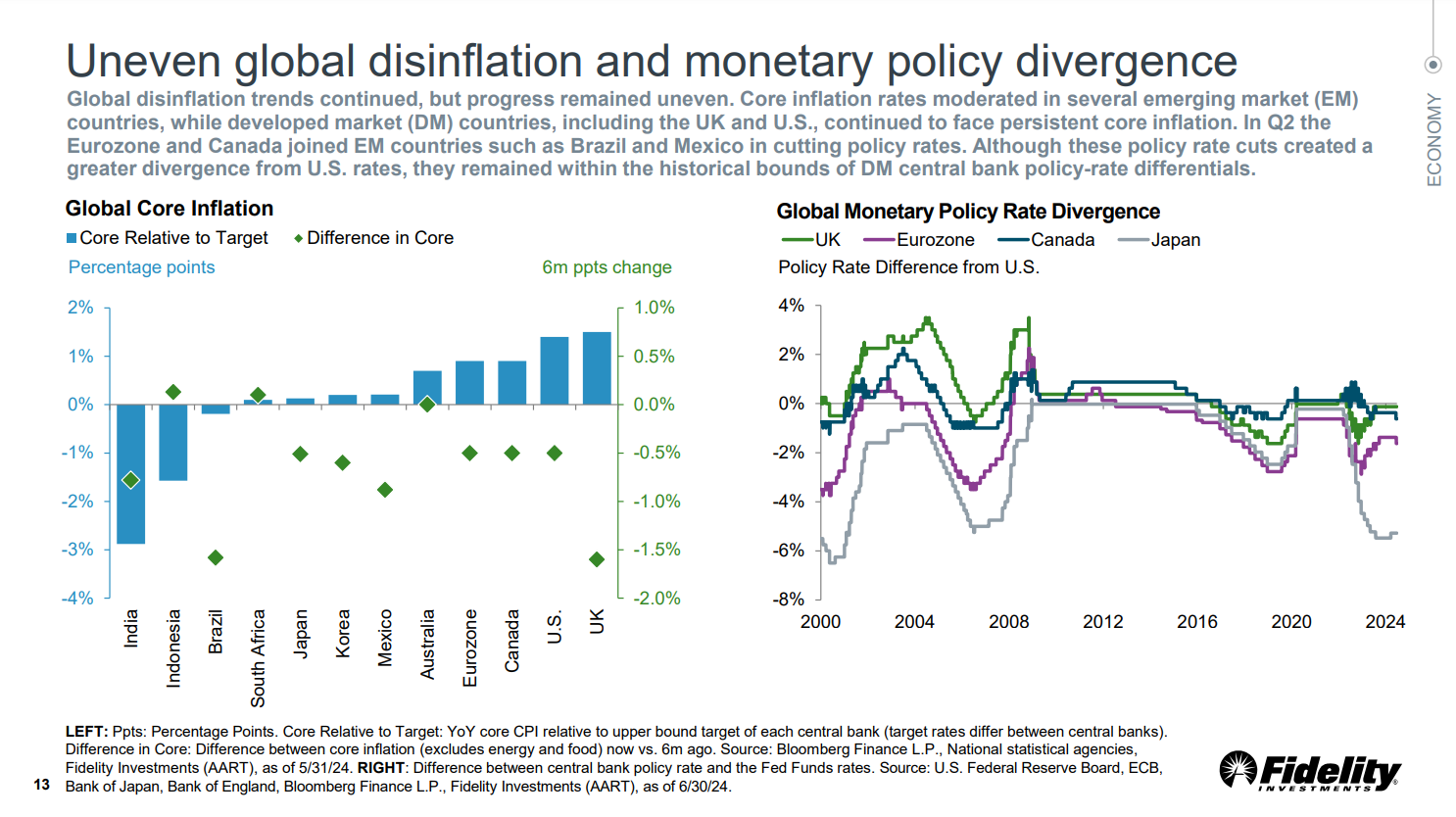
The Bank of Canada continued its easing cycle on October 23, 2024, reducing the policy rate by 50 basis points to 3.75%—its largest cut this year. Canada’s CPI has fallen to 1.6%, below the 2% target, with core inflation now under 2.5%. While growth remains modest and the labour market soft, excess supply and lower global oil prices are helping ease inflation, though shelter costs remain significant.¹

Looking forward, the Bank projects growth at 1.2% in 2024, increasing in 2025, with inflation expected to stay near 2%, keeping costs manageable for Canadians. The lower interest rate should gradually support growth in consumer spending, housing, and business investment.¹

Russell Investments notes that the U.S. economy is showing more signs of a potential soft landing as inflation has cooled significantly, prompting the Federal Reserve to cut interest rates. While employment growth is slowing and unemployment has risen slightly, layoffs remain limited, suggesting the job market is adjusting without typical recessionary job losses. The Federal Reserve’s proactive rate cuts aim to maintain economic stability, though risks remain if consumer caution leads to reduced spending and increased layoffs.²

Asset Update

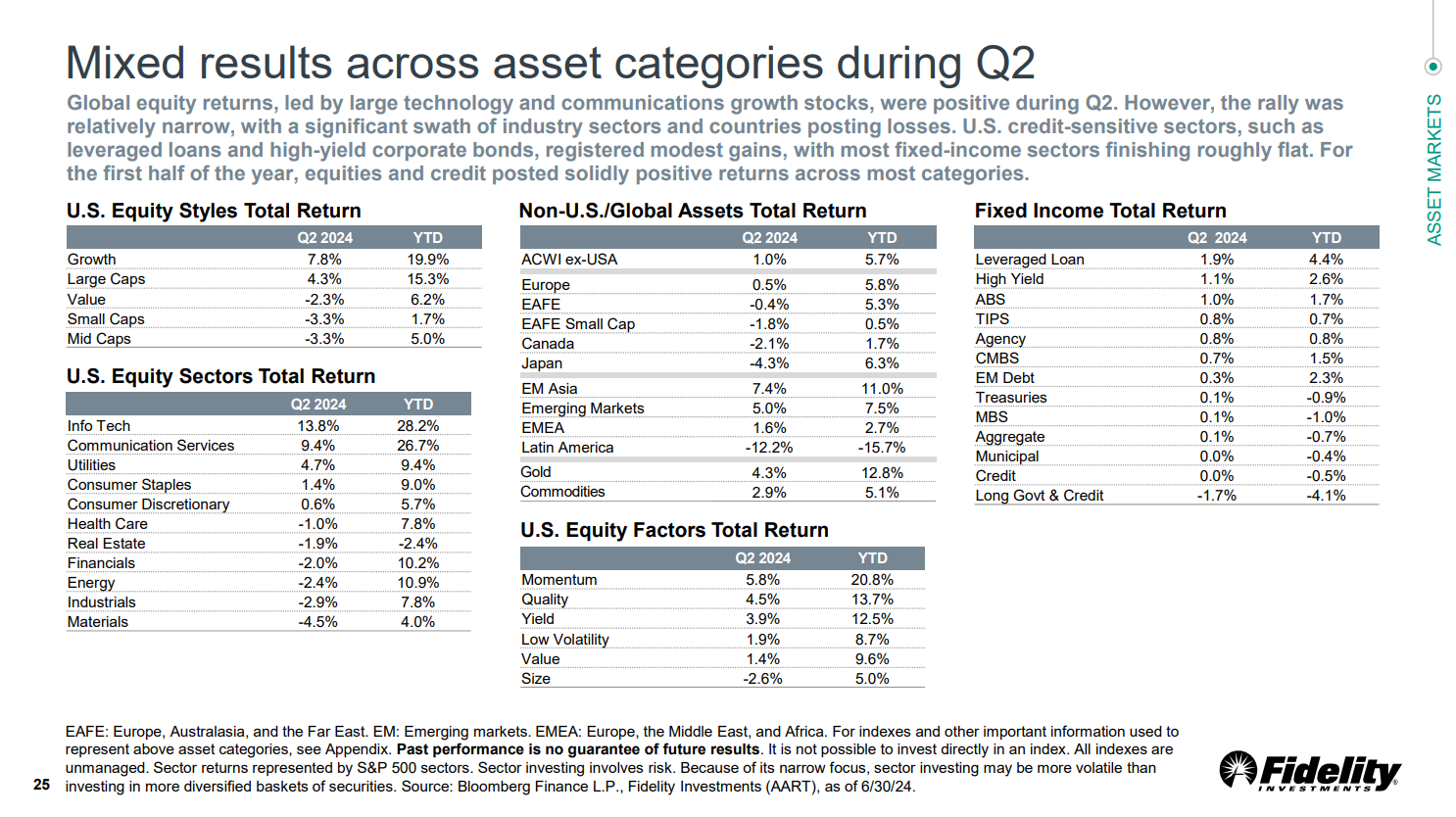
The S&P 500 delivered a 5.53% gain for the quarter, lifting its year-to-date (YTD) return to an impressive 20.81%³. Solid corporate fundamentals continue to support growth, with earnings expected to expand beyond just the largest companies.² Vanguard’s latest outlook reflects this with slightly adjusted long-term projections, lowering expectations for U.S. large-cap stocks while raising them for small-cap stocks over the next decade.⁴

Meanwhile, their 10-year fixed-income projections are offering returns similar to equities, but with less volatility, appealing to conservative investors.⁴ Still, Russell notes that recent drops in Treasury yields have brought them to fair value, prompting some portfolios to reduce their bond holdings.²

Since they believe equities are priced for a stable economic adjustment, the possibility of a tougher downturn adds some risk. They underscore the importance of maintaining diversified U.S. portfolios to manage potential market swings effectively.²

Hot Topic: Red or Blue

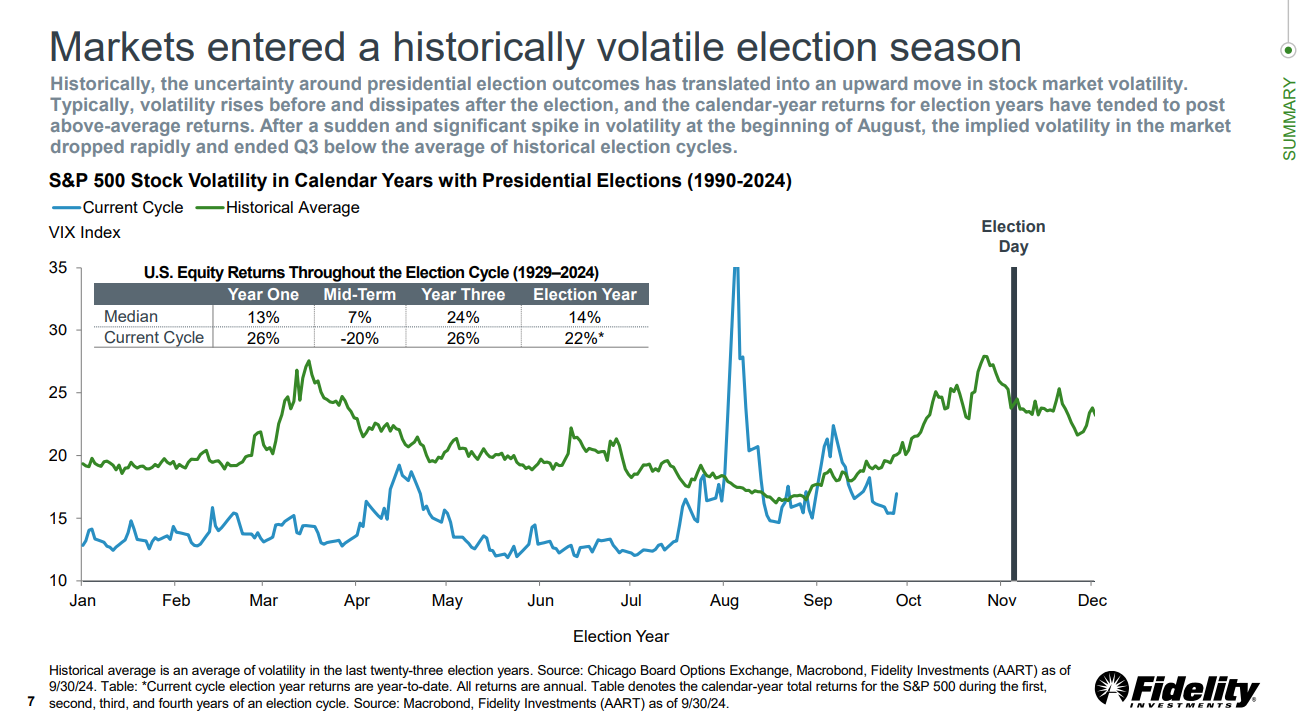
As the 2024 U.S. election approaches, investors can expect continued market volatility beyond typical business cycle uncertainties. Russell has highlighted that key economic risks to monitor include potential tariff increases, changes to corporate tax rates, and challenges to Federal Reserve independence. Despite these short-term concerns, they note that historical trends show that U.S. stocks have generally trended upward over the long term, regardless of which party controls the White House. Moreover, diversified portfolios have typically delivered positive returns in election years, a pattern expected to continue in 2024.² While political outcomes may create short-term market fluctuations, maintaining a well-balanced, diversified portfolio aligned with long-term financial goals remains a prudent strategy for navigating election-year uncertainties.

Summary

Photo by Luca Bravo on Unsplash

The Bank of Canada accelerated rate cuts last quarter, during increasing economic pressure for Canadians. In contrast, the U.S. has navigated its economic environment more effectively, offering greater stability and boosting confidence in U.S. assets, even amid higher valuations. As the U.S. election approaches, investors can expect continued market volatility. With this and the U.S. potentially positioned for a soft landing, diversification across asset classes and regions is essential to manage market volatility and shield against economic uncertainty.

We encourage you to connect with your financial advisor to ensure your portfolio aligns with your life stage and financial goals, enhancing resilience in an evolving market.


Sources:

[1] Bank of Canada Media Relations. (Oct. 23, 2024). Bank of Canada reduces policy rate by 50 basis points to 3¾%. https://www.bankofcanada.ca/2024/10/fad-press-release-2024-10-23/ 

[2] Russell Investments. (Accessed on Oct 29. 2024). Q4 2024 Global Market Outlook: DEFINITELY MAYBE.  https://russellinvestments.com/ca/global-market-outlook

[3] S&P Dow Jones Indices. (Oct. 2, 2024). U.S. Equities Market Attributes September 2024https://www.spglobal.com/spdji/en/commentary/article/us-equities-market-attributes  

[4] Vanguard Investment Strategy Group, global economics and markets team. (Oct. 22, 2024). Market perspectives. https://advisors.vanguard.com/insights/article/series/market-perspectives

[5] Fidelity Investments. (Accessed on Oct. 29, 2024). Quarterly Market Update: Fourth Quarter 2024. https://institutional.fidelity.com/app/literature/item/956327.html

The comments contained herein are a general discussion of certain issues intended as general information only and should not be relied upon as tax or legal advice. Please obtain independent professional advice, in the context of your particular circumstances. This article was written, designed and produced by Financial Literacy Counsel, a registered trade name with Investia Financial Services Inc., and does not necessarily reflect the opinion of Investia Financial Services Inc. The information contained in this article comes from sources we believe reliable, but we cannot guarantee its accuracy or reliability. The opinions expressed are based on an analysis and interpretation dating from the date of publication and are subject to change without notice. Furthermore, they do not constitute an offer or solicitation to buy or sell any securities.

Mutual Funds and ETFs are offered through Investia Financial Services Inc. Commissions, trailing commissions, management fees and expenses all may be associated with mutual fund investments.  Please read the prospectus before investing. Mutual funds are not guaranteed, their values change frequently, and past performance may not be repeated.

Clients

2024 Q3 Market Update

Photo by Andrea Cau on Unsplash


Stay informed with our latest update on economic trends and investment strategies. Discover the impact of the Bank of Canada’s rate cuts, get the latest economic updates from Canada and the U.S., and review recent asset performance.

Macro Update

¹

This past quarter, the Bank of Canada implemented two rate cuts, bringing its policy rate down to 4.5%. With a June inflation rate of 2.7%, they maintain expectations that Canada’s core inflation will decline to about 2.5% by the end of the year and reach its 2% target in 2025. The Bank’s decision to reduce the policy interest rate is due to easing broad inflationary pressures and excess supply, while acknowledging that high price pressures in shelter and services are keeping inflation elevated. Future monetary policy will be guided by ongoing assessments of these opposing inflationary forces, with a commitment to achieving price stability².

Russell Investments reiterated that a contraction of over 3% in per-capita GDP over the past two years indicates weaker economic health than headline GDP figures suggest. Additionally, The unemployment rate has risen from 5.4% to 6.2% over the past year. This increase reflects difficulties in absorbing the current influx of immigrants into the labour market³.

In the U.S., Vanguard reports that economic growth indicators, such as productivity gains and retail sales, are showing signs of slowing, leading them to anticipate 2024 GDP growth of around 2.0%. Despite recent favorable inflation readings, which have spurred market expectations of a Fed rate cut in September, Vanguard predicts that the Fed may only implement a modest rate cut in 2024 due to persistent high shelter inflation and a need to balance economic risks⁴.

¹

Asset Update

¹

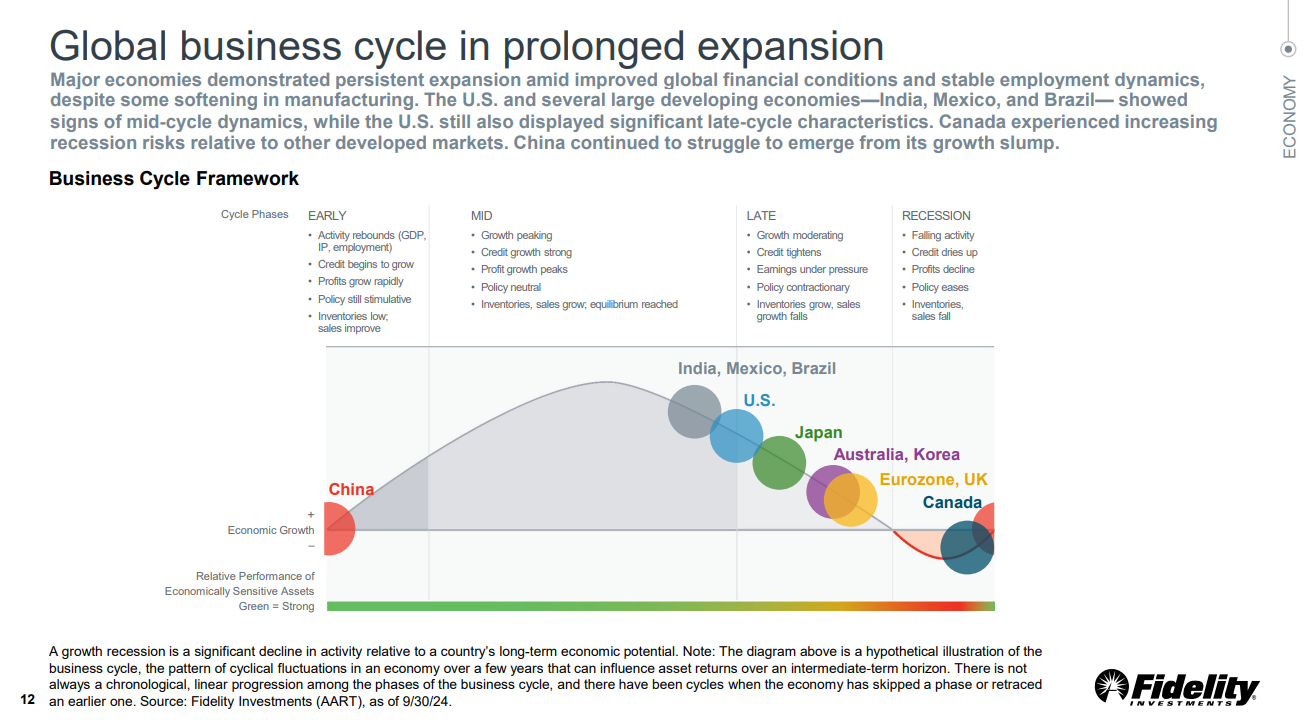
Last quarter we saw the S&P 500 start off with a slight dip, but managed to rally and end June with year-to-date returns at 14.48%⁵. Fidelity’s analysis echos its first quarter findings, showing that “Magnificent Seven” accounted for a 17% return, while the remaining 493 stocks were flat¹.

Vanguard’s updated 10 year projections show U.S. large-cap equities ranging from 3.2-5.2%, while small-cap and value have higher projections from 4.4%-6.8%, but carry more risk⁴. Though valuations may be attractive, Russell adds extra caution as they still believe there is a 35% recession risk in the U.S., which would have a stronger negative impact on small-cap companies³.

Similarly, Russell warns that current valuations of Canadian shares are reasonable, but economic concerns warrant a cautious stance. Despite improved earnings-per-share (EPS) growth estimates, potential downturns could harm corporate profitability. They believe that given the economic uncertainty and continued potential BoC rate cuts, government bonds are expected to perform well. They are seen as a safe investment, especially if a recession occurs³.

Summary

Photo by Javier Allegue Barros on Unsplash

The past quarter has been marked by significant economic adjustments, notably the Bank of Canada’s rate cuts. On the asset front, despite positive performance in major indices like the S&P 500, analysts recommend cautious optimism given the potential for economic downturns. As we have seen each quarter, the market is full of surprises and timing is challenging to predict. In this context, diversification is key to managing risk and seizing opportunities, helping investors navigate market volatility and adapt to changing economic conditions.

If you have any questions about how your portfolio is positioned or if you have had any major life changes, we encourage you to contact your advisor!


Sources:

[1] Fidelity Investments. (Jul. 2024). Quarterly Market Update: Third Quarter 2024. https://institutional.fidelity.com/app/literature/item/956327.html

[2] Bank of Canada Media Relations. (Jul. 24, 2024). Bank of Canada reduces policy rate by 25 basis points to 4½%.  https://www.bankofcanada.ca/2024/07/fad-press-release-2024-07-24/

[3] Russell Investments. (Jul. 2024). Q3 2024 Global Market Outlook: THREE-SCENARIO PROBLEM. https://russellinvestments.com/-/media/files/ca/en/insights/global-market-outlook/2024-q3-gmo-full-report.pdf

[4] Vanguard Investment Strategy Group, global economics and markets team. (Jul. 24, 2024). Market perspectives. https://advisors.vanguard.com/insights/article/series/market-perspectives#projected-returns

[5] S&P Dow Jones Indices. (Accessed on Jul. 26, 2024). S&P 500®https://www.spglobal.com/spdji/en/commentary/article/us-equities-market-attributes  

The comments contained herein are a general discussion of certain issues intended as general information only and should not be relied upon as tax or legal advice. Please obtain independent professional advice, in the context of your particular circumstances. This article was written, designed and produced by Financial Literacy Counsel, a registered trade name with Investia Financial Services Inc., and does not necessarily reflect the opinion of Investia Financial Services Inc. The information contained in this article comes from sources we believe reliable, but we cannot guarantee its accuracy or reliability. The opinions expressed are based on an analysis and interpretation dating from the date of publication and are subject to change without notice. Furthermore, they do not constitute an offer or solicitation to buy or sell any securities.

Mutual Funds and ETFs are offered through Investia Financial Services Inc. Commissions, trailing commissions, management fees and expenses all may be associated with mutual fund investments.  Please read the prospectus before investing. Mutual funds are not guaranteed, their values change frequently, and past performance may not be repeated.

Doctors

Get to Know Our Advisors: Jacob Chang

Jacob Chang

Jacob is an Associate Advisor, who joined our team earlier last year, bringing 9 years of experience in the financial industry. He typically helps young individuals/families (25-45 years old) who are:
• Planning to buy their first or second house in Vancouver/Toronto
• Unsure how to optimize finances (especially with a spouse and/or incorporated business)
• Focused on raising their young children

What inspired you to become a financial advisor?

My dad died unexpectedly at age 55. Our family was financially and emotionally unprepared, and my mom and I had to learn very quickly. The fear of losing our home and the weight of responsibility was immense, especially with two minor siblings. Every small decision cost us thousands of dollars. Due to the severe stress and fatigue, my doctor diagnosed me with stress-related shingles at 17 years old.

Thankfully, we had several amazing advisors. I was surprised that, in just a single conversation, they could save our family huge amounts of money and countless hours of time, stress, and energy. Their guidance inspired me to become the kind of advisor that they were to my family.

Can you walk us through your journey and key moments that brought you to where you are now?

  • In 2015 I met Sunny Lam CFP,RFP and Ken Chong CPA,CA. They taught me to love investing. And to love insurance even more. And to love tax planning even more!
  • In 2016 I worked as a stock analyst for Lieh Wang CFA. He taught me how to invest objectively and wisely.
  • In 2017 I met Barry Hawn CPA,CA, Personal Finance Professor at Western University. He taught me the joys of teaching Personal Finance.
  • In 2019 I learned about value investing from Professor George Athanassakos, who learned from Warren Buffett.
  • In 2021 I met Ivan Chen CFP,CHS,CKA,CLU,EPC,CPCA,CEA,MFA-P. He taught me about Biblical Stewardship and taught me how to go above and beyond for clients. In 2021 I also lectured my first class at Simon Fraser University.
  • In 2023 I met Bobby Ning CFP,EPC and Alphil Guilaran. I am currently learning the nuances and complexities of financial planning for medical professionals, business owners, and Family Offices.

What is your favourite aspect of working with your clients?

My favourite aspect of work is simply meeting my clients and learning from each other.

If I wasn’t paid, I would still be doing this job.

Besides the paperwork, I rarely feel like I’m working… it just feels like I’m chatting with my friends all day!

Can you share a moment with a client that was particularly rewarding or meaningful to you?

One of my financial planning mentors was working with a client who had just entered a very tough financial situation. This situation resulted in them (the client) taking a job that required a 3-hour commute. After one of our meetings (and careful consideration), my mentor handed his car keys to the client and told them to keep it.

My mentor taught me that many assets are good investments, but the best investments are in people.

Every family should review their financial plans with a lawyer, accountant, and financial planner.

I cannot count the number of times my mentors and I have heard the words “I wish we met you earlier.”

A 20-minute conversation can save a person a lifetime of despair, grief, pain, and regret. A second opinion costs nothing, but ignorance could cost you everything.

What is one piece of financial advice you believe everyone should follow?

If you would like to learn more about working with Jacob, you can review his LinkedIn profile here. Think he is a good match for your situation? Let us know here!

The comments contained herein are a general discussion of certain issues intended as general information only and should not be relied upon as tax or legal advice. Please obtain independent professional advice, in the context of your particular circumstances. This article was written, designed and produced by Financial Literacy Counsel, a registered trade name with Investia Financial Services Inc., and does not necessarily reflect the opinion of Investia Financial Services Inc. The information contained in this article comes from sources we believe reliable, but we cannot guarantee its accuracy or reliability. The opinions expressed are based on an analysis and interpretation dating from the date of publication and are subject to change without notice. Furthermore, they do not constitute an offer or solicitation to buy or sell any securities.

Mutual Funds are offered through Investia Financial Services Inc. Commissions, trailing commissions, management fees and expenses all may be associated with mutual fund investments.  Please read the prospectus before investing. Mutual funds are not guaranteed, their values change frequently, and past performance may not be repeated.

Clients, Families, Financial Planning, Taxes

2024 Summer Financial Checklist

Photo by Natalya Zaritskaya on Unsplash

With the school year wrapping up, many transitions are underway. Children are starting their summer break, and families are planning trips, from beach visits to longer holidays abroad. Recent medical school graduates are also stepping into their new roles as residents.

No matter your situation, our team at FLC has updated our summer checklist to help you manage your finances during these changes. As always, feel free to reach out to your advisor if you have any questions or want to discuss any of these items further.

Investment Top-Ups

  • RESP – You can contribute up to $2,500 per child this year to maximize the grant. If you have missed contributions in past years, you can contribute up to an additional $2,500 as a catch-up.
  • RDSP – Depending on your family’s income, you can contribute $1,000-$1,500 to maximize the grant. For more information, click here.
  • TFSA – This year’s additional contribution room is $7,000. Remember to check for any unused contribution room from past years too!
  • FHSA – This is a helpful way to save for your first home and reduce your taxes for the year. You have $8,000 of additional room this year. Remember that you will only start accumulating room in the year that you open the account.

Cybersecurity Tip: review your existing passwords for your investment and insurance accounts. Many companies are moving towards multi-factor authentication to help keep your information secure.

Photo by Sandy Ravaloniaina on Unsplash

Legal and Accounting

  • *New* Capital Gains Tax – On June 25th, this capital gains inclusion rate will increase to 66.7%. This will apply to amounts exceeding $250,000 for individuals and on the first dollar for corporations. Be sure to review your investments with your advisor to determine if any actions should be taken ahead of the change.
  • Corporate Taxes – Many corporations have a year-end during the summer. Start preparing your tax package to submit to your accountant and check this off your to-do list!
  • Wills – Ensure your will is up to date. If you do not have one, we recommend working with a lawyer to create one. At the very least, you can easily create one online at willful.co so that you have something in place. Talk to us to find out if you qualify for a discount.
  • Bookkeeping – get your bookkeeping back on track and avoid having to do it during the busier holiday season.

Photo by Khachik Simonian on Unsplash

Travel

  • Insurance – Remember to ensure you have travel insurance before leaving for your vacation to protect your family from unexpected and costly medical expenses.
  • Inspect what you Expect – Review your travel insurance coverage details before your trip so that you are better prepared in the event of an emergency. Knowing the number to call and the nearest approved hospital is especially helpful when time is of the essence.
  • Spending Plan – Consider using a credit card without foreign fee transactions to save up to 2.5% per transaction.

Photo by Andrew Ruiz on Unsplash

Last, but not least…

Remember to schedule a check-in with your financial advisor. Enjoy the summer and we will meet-up with you in the fall!


The comments contained herein are a general discussion of certain issues intended as general information only and should not be relied upon as tax or legal advice. Please obtain independent professional advice, in the context of your particular circumstances. This article was written, designed and produced by Financial Literacy Counsel, a registered trade name with Investia Financial Services Inc., and does not necessarily reflect the opinion of Investia Financial Services Inc. The information contained in this article comes from sources we believe reliable, but we cannot guarantee its accuracy or reliability. The opinions expressed are based on an analysis and interpretation dating from the date of publication and are subject to change without notice. Furthermore, they do not constitute an offer or solicitation to buy or sell any securities.

Mutual Funds are offered through Investia Financial Services Inc. Commissions, trailing commissions, management fees and expenses all may be associated with mutual fund investments.  Please read the prospectus before investing. Mutual funds are not guaranteed, their values change frequently, and past performance may not be repeated.

1 2
Privacy Settings
We use cookies to enhance your experience while using our website. If you are using our Services via a browser you can restrict, block or remove cookies through your web browser settings. We also use content and scripts from third parties that may use tracking technologies. You can selectively provide your consent below to allow such third party embeds. For complete information about the cookies we use, data we collect and how we process them, please check our Privacy Policy
Youtube
Consent to display content from - Youtube
Vimeo
Consent to display content from - Vimeo
Google Maps
Consent to display content from - Google
Spotify
Consent to display content from - Spotify
Sound Cloud
Consent to display content from - Sound
BOOK AN APPOINTMENT