Book a Workshop
Category

Doctors

Home / Doctors
Doctors

Get to Know Our Advisors: Jacob Chang

Jacob Chang

Jacob is an Associate Advisor, who joined our team earlier last year, bringing 9 years of experience in the financial industry. He typically helps young individuals/families (25-45 years old) who are:
• Planning to buy their first or second house in Vancouver/Toronto
• Unsure how to optimize finances (especially with a spouse and/or incorporated business)
• Focused on raising their young children

What inspired you to become a financial advisor?

My dad died unexpectedly at age 55. Our family was financially and emotionally unprepared, and my mom and I had to learn very quickly. The fear of losing our home and the weight of responsibility was immense, especially with two minor siblings. Every small decision cost us thousands of dollars. Due to the severe stress and fatigue, my doctor diagnosed me with stress-related shingles at 17 years old.

Thankfully, we had several amazing advisors. I was surprised that, in just a single conversation, they could save our family huge amounts of money and countless hours of time, stress, and energy. Their guidance inspired me to become the kind of advisor that they were to my family.

Can you walk us through your journey and key moments that brought you to where you are now?

  • In 2015 I met Sunny Lam CFP,RFP and Ken Chong CPA,CA. They taught me to love investing. And to love insurance even more. And to love tax planning even more!
  • In 2016 I worked as a stock analyst for Lieh Wang CFA. He taught me how to invest objectively and wisely.
  • In 2017 I met Barry Hawn CPA,CA, Personal Finance Professor at Western University. He taught me the joys of teaching Personal Finance.
  • In 2019 I learned about value investing from Professor George Athanassakos, who learned from Warren Buffett.
  • In 2021 I met Ivan Chen CFP,CHS,CKA,CLU,EPC,CPCA,CEA,MFA-P. He taught me about Biblical Stewardship and taught me how to go above and beyond for clients. In 2021 I also lectured my first class at Simon Fraser University.
  • In 2023 I met Bobby Ning CFP,EPC and Alphil Guilaran. I am currently learning the nuances and complexities of financial planning for medical professionals, business owners, and Family Offices.


What is your favourite aspect of working with your clients?

My favourite aspect of work is simply meeting my clients and learning from each other.

If I wasn’t paid, I would still be doing this job.

Besides the paperwork, I rarely feel like I’m working… it just feels like I’m chatting with my friends all day!

Can you share a moment with a client that was particularly rewarding or meaningful to you?

One of my financial planning mentors was working with a client who had just entered a very tough financial situation. This situation resulted in them (the client) taking a job that required a 3-hour commute. After one of our meetings (and careful consideration), my mentor handed his car keys to the client and told them to keep it.

My mentor taught me that many assets are good investments, but the best investments are in people.

Every family should review their financial plans with a lawyer, accountant, and financial planner.

I cannot count the number of times my mentors and I have heard the words “I wish we met you earlier.”

A 20-minute conversation can save a person a lifetime of despair, grief, pain, and regret. A second opinion costs nothing, but ignorance could cost you everything.

What is one piece of financial advice you believe everyone should follow?

If you would like to learn more about working with Jacob, you can review his LinkedIn profile here. Think he is a good match for your situation? Let us know here!

The comments contained herein are a general discussion of certain issues intended as general information only and should not be relied upon as tax or legal advice. Please obtain independent professional advice, in the context of your particular circumstances. This article was written, designed and produced by Financial Literacy Counsel, a registered trade name with Investia Financial Services Inc., and does not necessarily reflect the opinion of Investia Financial Services Inc. The information contained in this article comes from sources we believe reliable, but we cannot guarantee its accuracy or reliability. The opinions expressed are based on an analysis and interpretation dating from the date of publication and are subject to change without notice. Furthermore, they do not constitute an offer or solicitation to buy or sell any securities.

Mutual Funds are offered through Investia Financial Services Inc. Commissions, trailing commissions, management fees and expenses all may be associated with mutual fund investments.  Please read the prospectus before investing. Mutual funds are not guaranteed, their values change frequently, and past performance may not be repeated.

Doctors

Insurance For Physicians – What Kinds Do You Need

Your journey to becoming a physician took years of challenges and commitment to complete . You remember the gruelling hours needed to write the MCAT, get through medical school, find your way to residency, complete residency, maybe a fellowship and finally get to start your practice.  Now, you may want to ensure that you can protect your income and plan your legacy for the next generation.

The good news is that there’s a variety of ways insurance can help you reach these goals.

Protect your income

If you want ensure your income is protected, three types of insurance can help you and your family are provided for:

  • Critical illness insurance provides you with a tax-free lump sum benefit payment if you have a serious illness such as a cancer, heart attack or stroke diagnosis. This will enable you to take the time needed to get back on your feet and allowing extra income for your partner to be there with you.
  • Disability insurance will replace up to seventy percent of your income if you are ill or injured and cannot work.
  • Life insurance can ensure that your family will be taken care of if you die prematurely. You can select an amount of coverage that is appropriate for your needs.

If you have a clinic, office expenses will continue to be incurred.  Having insurance that protects your office and staff can help protect your savings from being eroded by a disability. You should consider:

  • Overhead insurance to cover things like rent and salaries if you are unable to work for any reason.
  • Commercial office insurance covers your contents, against perils such as fire and includes liability coverage (this is different than the CMPA coverage).

Smart tax planning to increase your wealth

Life insurance, whether it is a term or permanent policy can protect your family’s lifestyle and outstanding obligations.

You can use a permanent life insurance policy to help allocate your investment portfolio by growing tax-free inside the policy while you are alive.

Life insurance proceeds are tax-free upon death, which can be used to mitigate estate taxes and pass the funds tax-free to your estate.

Maximize my estate and leave a legacy

There are several benefits to having life insurance as part of your estate:

  • Beneficiaries receive the death benefit tax-free.
  • Beneficiaries can use the death benefit to pay for funeral expenses or taxes on other assets.
  • Anyone can be the beneficiary of a life insurance policy – from your grandchildren to your favourite charity.

What’s next?

Having the right kind of insurance can help protect your income, minimize your taxes, and enable you to provide a meaningful legacy after your death.  Feel free to contact us to go through your goals to ensure you have your bases covered.

Business, Doctors

Easy Exit: Business Succession in a Nutshell


Getting into the world of business is a meticulous task, but so is getting out of it.

Whether you just started your business or you’ve been an entrepreneur for a long time, it is always a good idea to have an exit strategy.

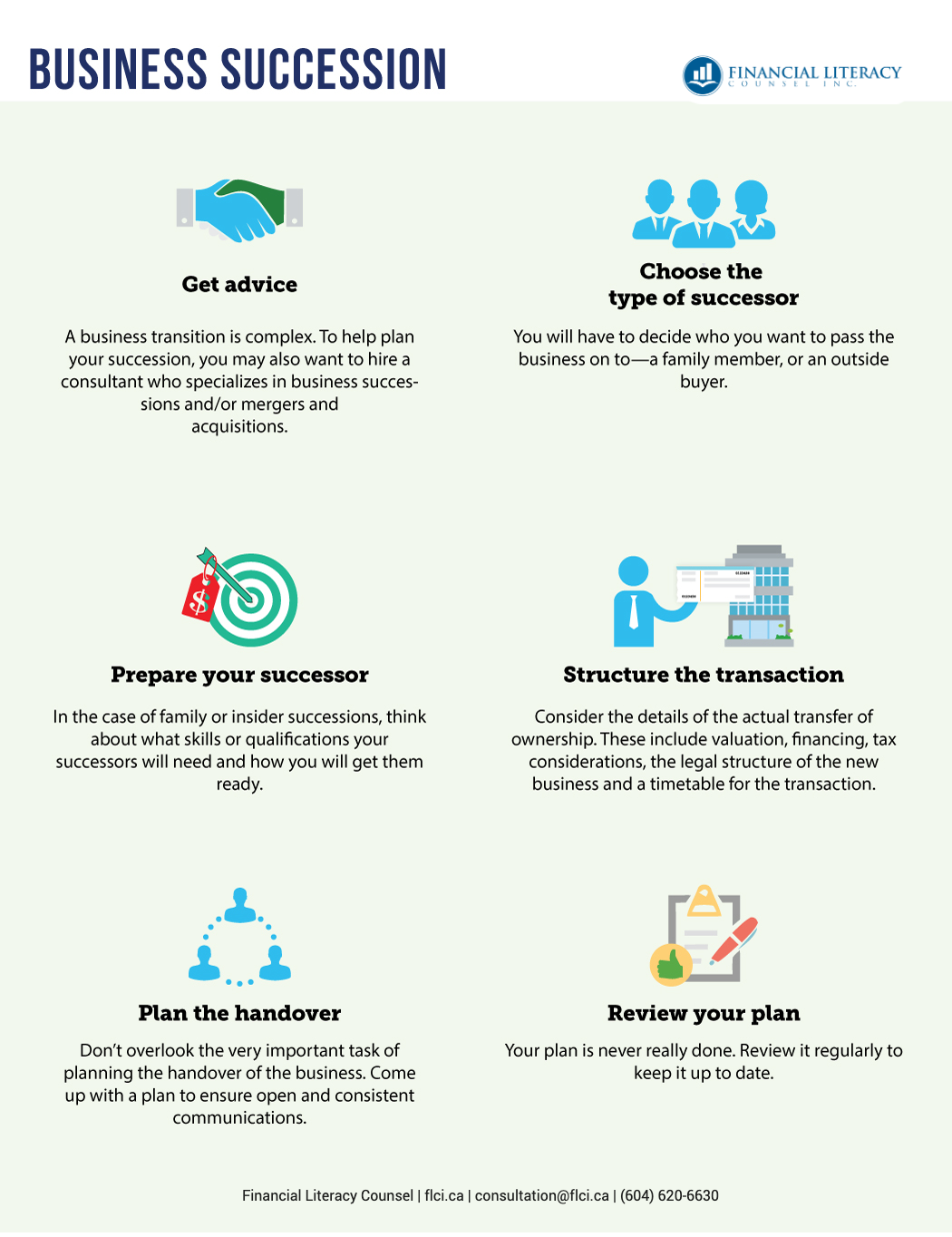
Below, we’ve answered a few questions you may have about planning your business succession strategy.

  • Who do I talk to about succession planning?

First, talk to your key advisors, including bankers and financial partners, your accountant and lawyers. If your company has an advisory board, you should consult them as well. Determining how to go about the transition requires careful planning; depending on how you choose to go about your business succession plan, you may decide to hire a specialist or a consultant

  1. Who should I choose to be my successor?

There are a few ways to go about this; however, it will ultimately be your personal choice. You may pass your business on to a family member or to your top executives or managers. You may also choose to sell it to an outsider. Whichever path you choose, you can decide how much you want to be involved in the business after you pass it on; that is, if you want to be involved at all.

  1. When should I inform my successor about my plans?

While a surprise inheritance may be heartwarming, it is  not the same when it comes to inheriting a business. Getting a successor ready—whether it’s a family member or someone from your company—requires careful planning and training. As soon as you’ve chosen a successor, it is best to get started on training, which includes helping them equip themselves with the skills, knowledge and qualifications necessary to run your business.

  1. How do I plan the transition itself?

The transition will be two-fold—transferring ownership and handing over the business, itself. As far as transferring ownership is concerned, you will need to consider legal and financial details. These include valuation, financing, and taxation. You also need to consider whether you wish to keep your current legal structure (corporation, sole proprietor, partnership, etc.) or if you (or your successor) would like to change it.

You also need to plan how to prepare various stakeholders for the transition. How will you prepare your customers, clients, and employees? What would be their level of involvement? Make sure that you put different strategies in place to ensure transparency and consistency in communicating changes to your business, especially when it is something as drastic as succession.

  1. Now that I have a business succession plan ready, can I go back to business as usual?

Not really. Your business and your clients’ needs may change over time. This means that you need to review and adjust your plan as your business evolves.

Privacy Settings
We use cookies to enhance your experience while using our website. If you are using our Services via a browser you can restrict, block or remove cookies through your web browser settings. We also use content and scripts from third parties that may use tracking technologies. You can selectively provide your consent below to allow such third party embeds. For complete information about the cookies we use, data we collect and how we process them, please check our Privacy Policy
Youtube
Consent to display content from - Youtube
Vimeo
Consent to display content from - Vimeo
Google Maps
Consent to display content from - Google
Spotify
Consent to display content from - Spotify
Sound Cloud
Consent to display content from - Sound
BOOK AN APPOINTMENT