Book a Workshop
Posts by

FLC

Home / Blog Archive
Clients

2024 Q2 Market Update

Photo by Mike Benna on Unsplash


Get insights on economic trends and investment strategies with our latest update. Learn about the Bank of Canada’s inflation outlook, current market dynamics, and key highlights from the 2024 Federal Budget, including changes to the capital gains tax and the Home Buyers Plan.

Macro Update: Steady as she goes

¹

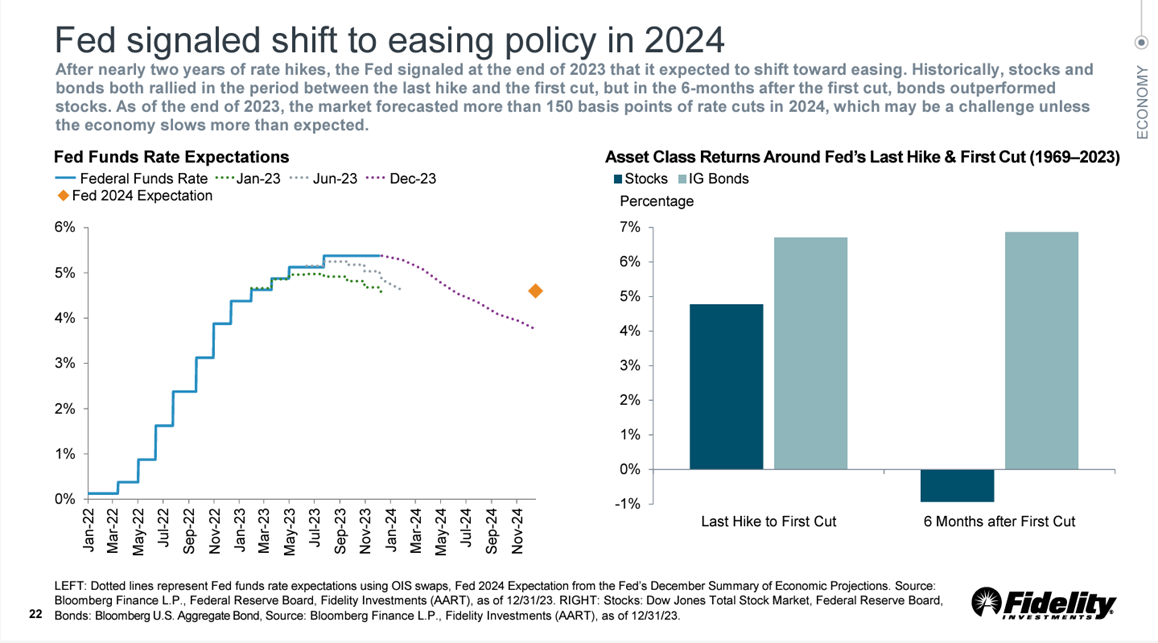
On April 10th, the Bank of Canada (BoC) opted to maintain its policy rate at 5%. They anticipate Consumer Price Index (CPI) inflation to hover around 3% in the first half of 2024 before moderating to below 2.5% in the latter half, ultimately reaching the 2% inflation target by 2025².

Russell Investments updated its Canadian recession estimation to occur within the next 12 to 18 months, pushing it into 2025. Immigration continues to bolster the overall economy, yet the current job creation rate doesn’t align with the influx of immigrants. Despite no official recession, GDP per capita has declined by 3.2% since the second quarter of 2022, which they suggest is a “standard-of-living recession”³. Higher debt levels and joblessness pose ongoing risks as indicators of soft demand persist in Canada, with slow sales growth particularly evident in sectors tied to discretionary consumption and residential real estate⁴.

In contrast, Vanguard’s view on the US economy appears more optimistic, with expected real economic growth of about 2.0% in 2024, surpassing their initial estimates of 0.5%. Shelter prices, a significant component of the core inflation, have increased by 5.7% year-over-year, contributing substantially to overall inflation⁵, similar to the current state in Canada.

Asset Update: Keeping the ship stocked
¹

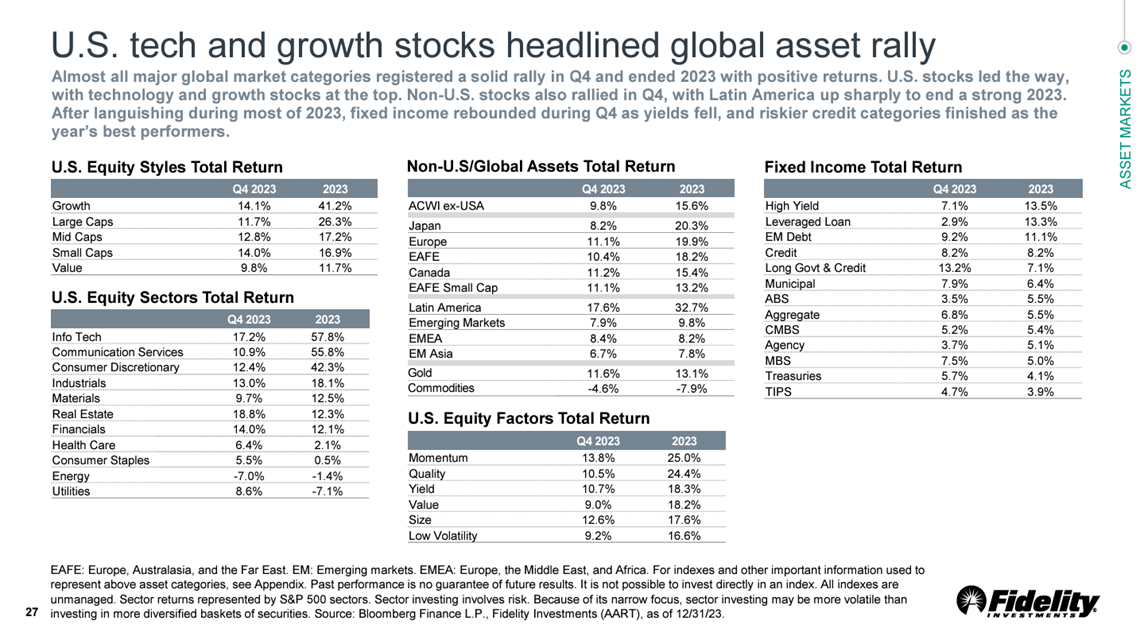
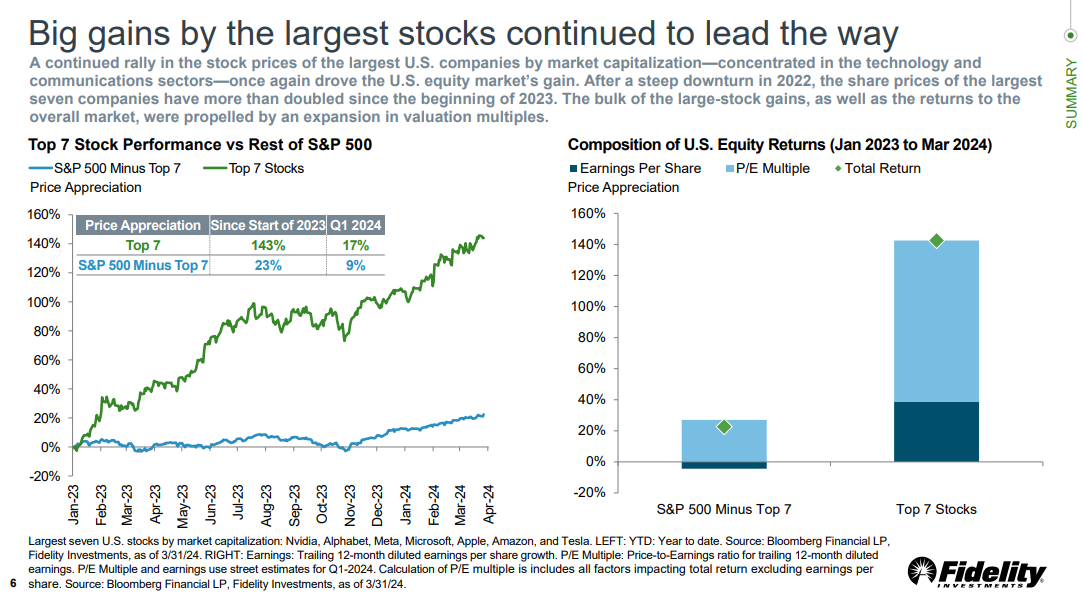
The S&P 500 ended a strong first quarter above 10%, but has pulled back since then, with year-to-date returns at 6.33% as of April 24, 2024⁶. Fidelity’s analysis highlights a continued significant performance gap within the index: by the close of the quarter, the “Magnificent Seven” stocks appreciated by 17%, nearly doubling the broader S&P 500’s growth rate, which stood at 9%¹.

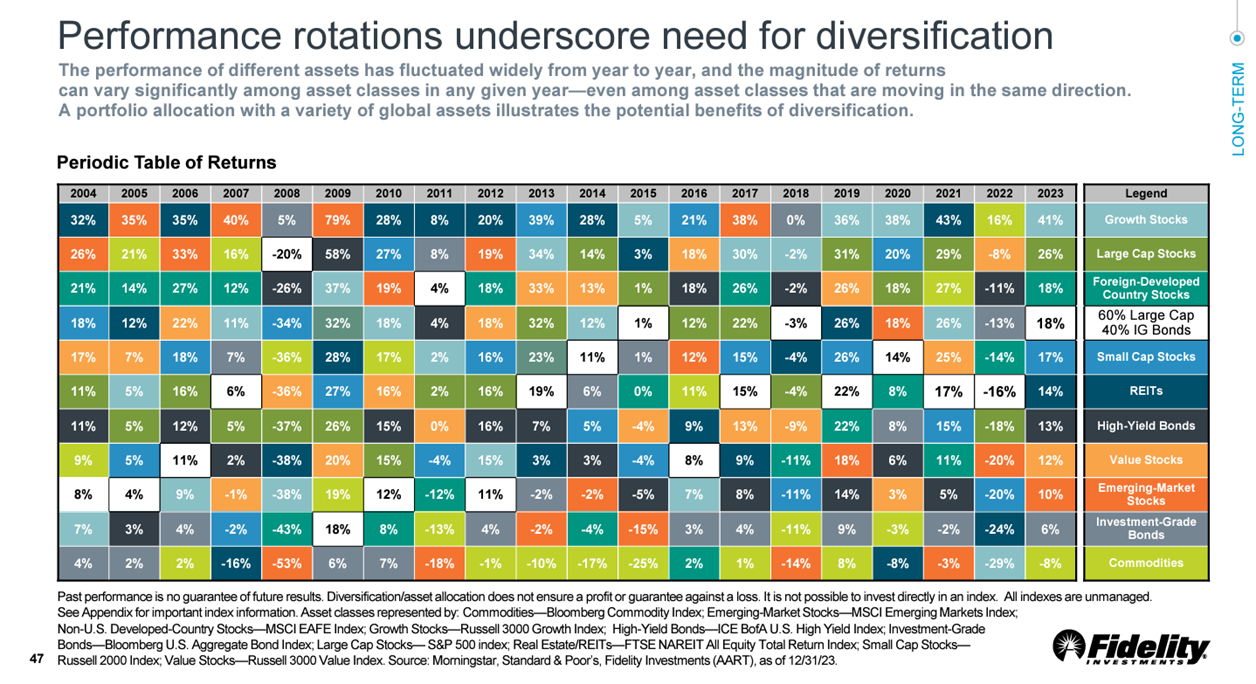
Shifting focus to portfolio strategies, Russell Investments has been prioritizing security selection and diversification to safeguard client outcomes amidst diverse scenarios anticipated in the coming year. While formerly favoring quality equities—companies with strong balance sheets and profitability—this preference was adjusted in February following a period of robust performance for these stocks³. Similarly, Vanguard suggests that though these equities are currently favorable, investors might contemplate maintaining some exposure to large-cap growth stocks. Many have thought these to be overbought, however, they may still have a runway for continued returns⁵. This underscores the value of a diversified portfolio for long-term growth.

Hot Topic: 2024 Federal Budget – is that an iceberg?

Photo by Tom Carnegie on Unsplash

Earlier this month, Canada’s Department of Finance presented the 2024 Federal Budget. By the next morning, many woke up to headlines surrounding the capital gains tax increase from 50% to 67%. The Department of Finance emphasized that this would primarily affect Canada’s highest income earners, as, for individuals, it only applies to amounts in excess of $250,000⁷. However, professionals who are incorporated or planning to incorporate will have to do a deeper dive into potential implications. There will also be greater considerations for estate planning and real estate investment properties.

Prior to the full budget release, the Finance Minister announced an update to the Home Buyers Plan. Canadians can now withdraw up to $60,000, a substantial increase from the previous limit of $35,000, from their tax-sheltered RRSP to facilitate first-time home purchases. This adjustment is expected to provide valuable assistance to those striving for homeownership. You can find additional details about this development on Investment Executive here⁸.

Summary

Photo by Javier Allegue Barros on Unsplash

As we navigate these economic shifts and policy changes together, it’s essential to conduct regular reviews of your financial plan. Remember to keep the principle of diversification top of mind in your investment strategy. Diversified portfolios not only help manage risks but also maximize growth opportunities over time, regardless of market fluctuations. If you’re uncertain about how the Federal Budget developments may affect your financial journey, we encourage you to reach out and connect with your advisor. Your financial well-being is our priority, and we’re here to provide personalized guidance and support tailored to your individual goals and concerns.


Sources:

[1] Fidelity Investments. (Apr. 2024). Quarterly Market Update: Second Quarter 2024. https://institutional.fidelity.com/app/literature/white-paper/9883196/second-quarter-2024-quarterly-market-update.html

[2] Bank of Canada Media Relations. (Apr. 10, 2024). Bank of Canada maintains policy rate, continues quantitative tightening. https://www.bankofcanada.ca/2024/04/fad-press-release-2024-04-10/

[3] Russell Investments. (Apr. 2024). Q2 2024 Global Market Outlook: PENT-UP EXUBERANCE. https://russellinvestments.com/-/media/files/ca/en/insights/global-market-outlook/2024-q2-gmo-full-report.pdf

[4] Bank of Canada. (Apr. 1, 2024). Business Outlook Survey—First Quarter of 2024. https://www.bankofcanada.ca/2024/04/business-outlook-survey-first-quarter-of-2024/

[5] Dziuba, R & Sheridan, M. (Mar. 22, 2024). Portfolio perspectives. https://advisors.vanguard.com/insights/article/series/market-perspectives

[6] S&P Dow Jones Indices. (Accessed on Apr. 24, 2024). S&P 500®https://www.spglobal.com/spdji/en/commentary/article/us-equities-market-attributes  

[7] Government of Canada. (Accessed on Apr. 25, 2024). Budget 2024: Chapter 8: Tax Fairness for Every Generation. https://www.budget.canada.ca/2024/report-rapport/chap8-en.html

[8] Mezzeta, R. (Apr. 11, 2024). Feds boost home buyers plan withdrawal limit to $60,000. https://www.budget.canada.ca/2024/report-rapport/chap8-en.html

The comments contained herein are a general discussion of certain issues intended as general information only and should not be relied upon as tax or legal advice. Please obtain independent professional advice, in the context of your particular circumstances. This article was written, designed and produced by Financial Literacy Counsel, a registered trade name with Investia Financial Services Inc., and does not necessarily reflect the opinion of Investia Financial Services Inc. The information contained in this article comes from sources we believe reliable, but we cannot guarantee its accuracy or reliability. The opinions expressed are based on an analysis and interpretation dating from the date of publication and are subject to change without notice. Furthermore, they do not constitute an offer or solicitation to buy or sell any securities.

Mutual Funds and ETFs are offered through Investia Financial Services Inc. Commissions, trailing commissions, management fees and expenses all may be associated with mutual fund investments.  Please read the prospectus before investing. Mutual funds are not guaranteed, their values change frequently, and past performance may not be repeated.

Financial Planning

Breaking the Silence: Addressing Money Taboos for Financial Wellness

The following article is written by our Associate Advisor: Jee-Woon Jonathan Ha, BA, RIS

It is often said that what gets measured gets improved. To accomplish this, it helps to have open conversations with your trusted peers about whatever it is you are attempting to improve upon. Whether it is a fitness goal or a new hobby, sharing the struggles and successes allows a person to understand where the gaps are and how improvements can be made.

However, regardless of where you were born or how you were raised, it seems that many cultures today have consistent topics that are taboo to talk about, including money. Despite its foundational importance and undeniable prevalence to the many aspects of our life, there is a pervasive discomfort surrounding money conversations that often hinders financial wellness.

Let’s dive into 4 money taboos and why we should start talking about them.

1. Debt Shame:

Personal Finances are simply not taught enough in school. Even business school graduates will leave their university campus grounds feeling confused and disorganized with their assets, debts and spending habits. This can lead to unexpected overspending and a dependence on debt, which can be so easy to get into but feel impossible to get out of. By normalizing conversations around debt, seeking support to develop debt repayment strategies and asking for accountability to successfully execute this plan, individuals can remove heavy emotional burdens and go back to sleeping peacefully at night knowing they are not chained down by their lender.

2. Inheritance and Estate Ignorance:

This one is taboo twofold considering we are discussing another subject that is silenced – death. However, Canadians often don’t realize that the biggest tax bill for an individual is often at their death. This is because in Canada, many of your personally owned assets are considered sold the day before you passed away, triggering a massive tax bill for the remaining loved ones to deal with. By having proper planning completed in preparation for this day, it will allow the individual’s wealth to pass to the next generation in a tax-efficient manner, rather than having a significant portion of their wealth go to the government in the form of taxes. Planning through avenues such as wills, trusts, insurance and beneficiaries will ensure that their wealth is preserved, managed and distributed according to their wishes.

3. Investment Intimidation:

Many people enjoy traveling from Vancouver to Vancouver Island, which usually requires a ferry ride. However, if someone is too intimated to take the ferry and hesitates to get on the boat, it can cause them to delay or miss their opportunity of getting to their goal. Likewise with our investments, a lack of financial literacy can cause someone to miss out on opportunities to grow their wealth to achieve retirement based on their desires. Avoiding discussions around investment strategies due to fear of judgement or appearing ignorant can cause hesitation to get on the ferry, but we are here to help you get sailing.

4. Spending Guilt:

Everywhere we go, we are constantly bombarded with messages that tell us we could be happier with more. This insatiable desire for more can cause us to become overly materialistic without any consideration for financial prudency. By adopting a balanced approach of savings vs spending, it is possible to fill up your photo album with meaningful experiences that money can buy while achieving your long-term goals at the same time. This often requires understanding how much is enough and having a target to pursue. Then, a purposeful spending plan follows, where you tell every dollar what to do rather than wondering where it went. The end result is a life comprising of guilt-free spending, all the while achieving financial freedom in the years to come.

Final Remarks

Our finances are so closely tied to our emotional and relational well-being. As a strong foundational component of our life, it is important to uncover the potential roadblocks that may hinder our progress towards reaching our financial goals. Open and honest discussions around these 4 drivers of money secrecy may help eliminate some of these roadblocks. So, let’s start talking about money – because financial wellness begins with breaking the silence.

If you would like to start the discussion on any of these topics with a professional, reach out to your financial advisor!


The comments contained herein are a general discussion of certain issues intended as general information only and should not be relied upon as tax or legal advice. Please obtain independent professional advice, in the context of your particular circumstances. This article was written, designed and produced by Financial Literacy Counsel, a registered trade name with Investia Financial Services Inc., and does not necessarily reflect the opinion of Investia Financial Services Inc. The information contained in this article comes from sources we believe reliable, but we cannot guarantee its accuracy or reliability. The opinions expressed are based on an analysis and interpretation dating from the date of publication and are subject to change without notice. Furthermore, they do not constitute an offer or solicitation to buy or sell any securities.

Mutual Funds are offered through Investia Financial Services Inc. Commissions, trailing commissions, management fees and expenses all may be associated with mutual fund investments.  Please read the prospectus before investing. Mutual funds are not guaranteed, their values change frequently, and past performance may not be repeated.

Clients

2024 Q1 Market Update

Photo by anthony maw on Unsplash


Join us as we explore the economic forecast and investment landscape, similar to checking the weather before stepping out. This quarter we navigate through the economic trends on inflation and interest rates, insights shaping financial climates, and the continued case for diversification.

Macro Update: Checking the Weather App

Much like forecasting the weather, forecasting the economy is an imperfect art. If they are at least directionally correct, we can rely on them for guidance on how to plan for the future.

The Bank of Canada (BoC) maintained a 5% policy rate on January 24, 2024, aligning with their previous announcements in the latter half of 2023. They highlighted that wage growth and shelter costs continue to contribute to elevated rates. As the economic climate aligns with projections, the expectation is that inflation will remain at approximately 3% for the coming months, gradually tapering to around 2.5% by the end of the year. Given these positive developments, the BoC has shifted its discussions from assessing whether the policy is “restrictive enough” to deliberating “how long it needs to stay”¹. This signal reinforces the consensus that interest rates have likely reached their peak, contingent on the economy’s anticipated path. It follows a similar U.S. signal sent at the end of 2023².

Russell Investments underscores a Bank of America survey revealing that 74% of fund managers do not foresee a U.S. recession in 2024, a statistic they approach with caution, deeming it overly optimistic³. Conversely, Canadians are more keenly feeling the impact of prevailing interest rate levels. Both Russell and Vanguard investments anticipate a mild recession still in the Canadian forecast this year, with predictions of a series of rate cuts by the end of 2024³,⁴. This projection is welcomed news, creating anticipation of warmer days after a prolonged winter, especially as consumer confidence continues to experience a chilling effect.

Asset Update: (Not so) Surprise Snow

Vancouver experienced one of its most pleasant Decembers in recent years, characterized by minimal rain and abundant sunshine that created a deceptively comfortable atmosphere. However, January brought a change with a light dusting of snow, catching many residents off guard during their commutes.

In the financial landscape, 2023 concluded positively for both stocks and fixed income, largely boosted by a robust performance in the final quarter². While the U.S. stock performance may tempt investors to concentrate on high-performing sectors such as growth and tech stocks, the team at Russell advises caution, highlighting that downside risk may outweigh the upside potential. Canadian equities boast a forward price-to-equity ratio of 12, appearing more attractive compared to the more expensive U.S. P/E of 18. This perceived value should also be shared with an acknowledgment that Canadian equities tend to be more cyclical and sensitive to economic downturns³.

Last quarter, we emphasized Vanguard’s perspective that projected fixed income returns fall within the band for U.S. equities, advocating for a diversified portfolio⁴. Given ongoing economic uncertainty and the understanding that fixed income prices typically ascend when interest rates decline, consider them to be your financial winter tires. In the event of an economic snowfall, they enhance your likelihood of reaching your financial destination unscathed.

Hot Topic: We can never be too careful…or can we?

“Rebalancing is a strategy of realigning your portfolio to your objectives and needs, which should be done at least once a year.”

– Bobby Ning, CFP and Co-Founder of FLC

In 2023, discomfort was prevalent, leading many investors to seek refuge in Guaranteed Investment Certificates (GICs) and High-Interest Savings Accounts (HISAs), offering a secure 5% return. While this approach proved effective for those with a shorter investment horizon, long-term investors may have foregone potential double-digit returns by avoiding a measured level of risk. As a gentle reminder, it’s prudent to schedule an annual review with your advisor. Rebalancing, the strategic realignment of your portfolio to align with your financial objectives, is a crucial exercise in restoring diversification. Additionally, your advisor may present alternative diversification opportunities for your excess cash that better align with your unique financial landscape, mirroring the adaptability required when navigating changing climates.
tions regarding your investments aligning with your long-term plan, it’s advisable to consult your financial advisor.
 

Summary

Photo by Ruben. on Unsplash

Much like checking a weather app, forecasting the economy offers imperfect yet directional insights. The Bank of Canada’s stable policy rate signals a projected economic trajectory, akin to anticipating shifting seasons. Contrasting sentiments between Canadian caution and U.S. optimism echo weather forecasts in different regions, emphasizing the need for diversified portfolios as protective measures. We strongly encourage you to reach out to your advisor if you have any questions about your current portfolio. Strategic realignments, like rebalancing portfolios, underscore the value of annual reviews, ensuring readiness for whatever financial weather lies ahead.


Sources:

[1]Macklem, Tiff. (Jan. 24, 2024). Monetary Policy Report Press Conference Opening Statementhttps://www.bankofcanada.ca/2024/01/opening-statement-2024-01-24/

[2] Fidelity Investments. (Jan. 2024). Quarterly Market Update: First Quarter 2024https://institutional.fidelity.com/app/proxy/content?literatureURL=/956327.PDF

[3] Russell Investments. (Jan. 2024). 2024 Annual Global Market Outlook: THE TWILIGHT ZONE. https://russellinvestments.com/-/media/files/ca/en/insights/global-market-outlook/2024-q1-gmo-summary_ca.pdf

[4] Vanguard Investment Strategy Group. (Jan. 19, 2024). Monthly outlook: Our investment and economic outlook, January 2024https://corporate.vanguard.com/content/corporatesite/us/en/corp/articles/investment-economic-outlook-jan-2024.html

The comments contained herein are a general discussion of certain issues intended as general information only and should not be relied upon as tax or legal advice. Please obtain independent professional advice, in the context of your particular circumstances. This article was written, designed and produced by Financial Literacy Counsel, a registered trade name with Investia Financial Services Inc., and does not necessarily reflect the opinion of Investia Financial Services Inc. The information contained in this article comes from sources we believe reliable, but we cannot guarantee its accuracy or reliability. The opinions expressed are based on an analysis and interpretation dating from the date of publication and are subject to change without notice. Furthermore, they do not constitute an offer or solicitation to buy or sell any securities.

Mutual Funds and ETFs are offered through Investia Financial Services Inc. Commissions, trailing commissions, management fees and expenses all may be associated with mutual fund investments.  Please read the prospectus before investing. Mutual funds are not guaranteed, their values change frequently, and past performance may not be repeated.

1 2
Privacy Settings
We use cookies to enhance your experience while using our website. If you are using our Services via a browser you can restrict, block or remove cookies through your web browser settings. We also use content and scripts from third parties that may use tracking technologies. You can selectively provide your consent below to allow such third party embeds. For complete information about the cookies we use, data we collect and how we process them, please check our Privacy Policy
Youtube
Consent to display content from - Youtube
Vimeo
Consent to display content from - Vimeo
Google Maps
Consent to display content from - Google
Spotify
Consent to display content from - Spotify
Sound Cloud
Consent to display content from - Sound
BOOK AN APPOINTMENT