
Book a Workshop
Posts by

FLC

Home / Blog Archive
Financial Planning

TFSA vs. RRSP – What you need to know to make the most of them in 2022

Tax-Free Savings Accounts (TFSA) and Registered Retirement Savings Plans (RRSP) can be significant savings vehicles. To help you understand how to make the most of them in 2022, we’ll compare the differences within the following areas:
  • Deposits

    • Contribution Room
    • Carry Forward
    • Contributions and Tax Deductibility
    • Tax Treatment of Growth
  • Withdrawals

    • Conversion Requirements
    • Tax Treatment
    • Government Benefits
    • Contribution Room

Deposits

How much contribution room do I have?

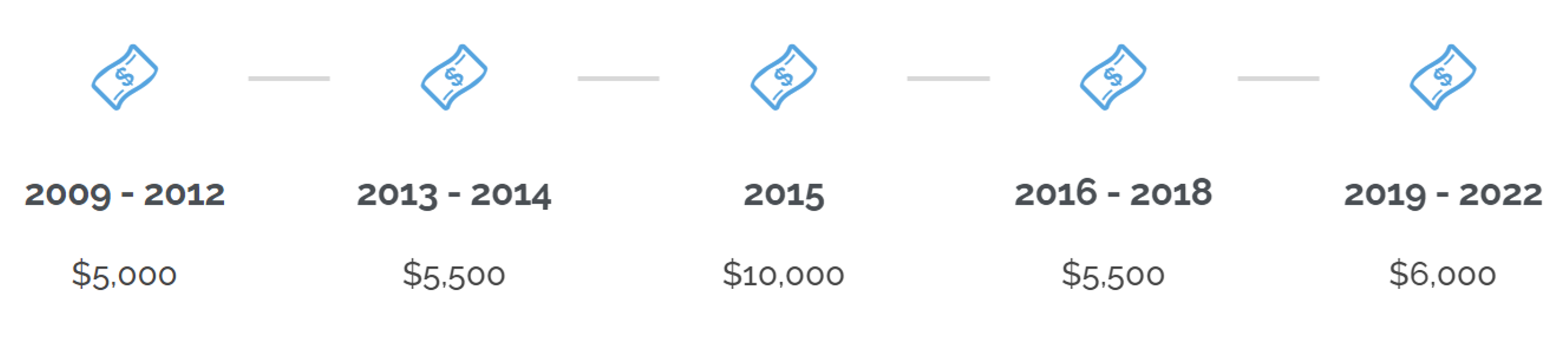
If you have not yet opened a TFSA, you can contribute up to $81,500 today. The TFSA contribution limit can change each year. The contribution amount allowed for each year since TFSAs were introduced in 2009 are as follows:
Alternatively, the RRSP contribution limit is always 18% of your pre-tax earnings from the previous year, up to the maximum contribution limit for that taxation year. For example, if you earned $60,000 in 2021, your contribution limit for 2022 would be $10,800 (18% x $60,000). If you earned over $162,277, your contribution limit would be capped at the maximum of $29,210.

How much contribution room can I carry forward?

If you choose not to contribute to your TFSA at all or do not contribute the maximum amount in a year, you can indefinitely carry forward your unused contribution room.

The only restrictions on this are that you must be a Canadian resident, older than 18, and have a valid social insurance number. In addition, if you make a withdrawal, the amount you withdrew is added to your annual contribution room for the following calendar year.

For an RRSP, you can carry forward your unused contribution room until the age of 71. When you turn 71, you must convert your RRSP into a Registered Retirement Income Fund (RRIF). If you make a withdrawal from your RRSP, it does not open up any additional contribution room.

Contributions and Tax Deductibility

TFSA contributions are not tax-deductible and are made with after-tax dollars, while RRSP contributions are tax-deductible and are made with pre-tax dollars.

Tax Treatment of Growth

One of the reasons it is essential to make both RRSP and TFSA contributions is that investment value growth is treated differently.

A TFSA is more suitable for short-term objectives like saving for a vacation or down-payment on a house because the investment value growth is tax-free. In addition, when you make a withdrawal from your TFSA, you will not have to pay income tax on the amount withdrawn.

The growth in an RRSP is tax-deferred, meaning you will not pay any taxes on your RRSP gains until you withdraw money from your future RRIF account; the account you convert your RRSP into at age 71. As a result, RRSPs are better suited for long-term objectives, like retirement. In addition, since you will have a lower income in retirement than when you are working, you will be in a lower tax bracket and pay less tax on your RRIF income.

Withdrawals
Conversion Requirements

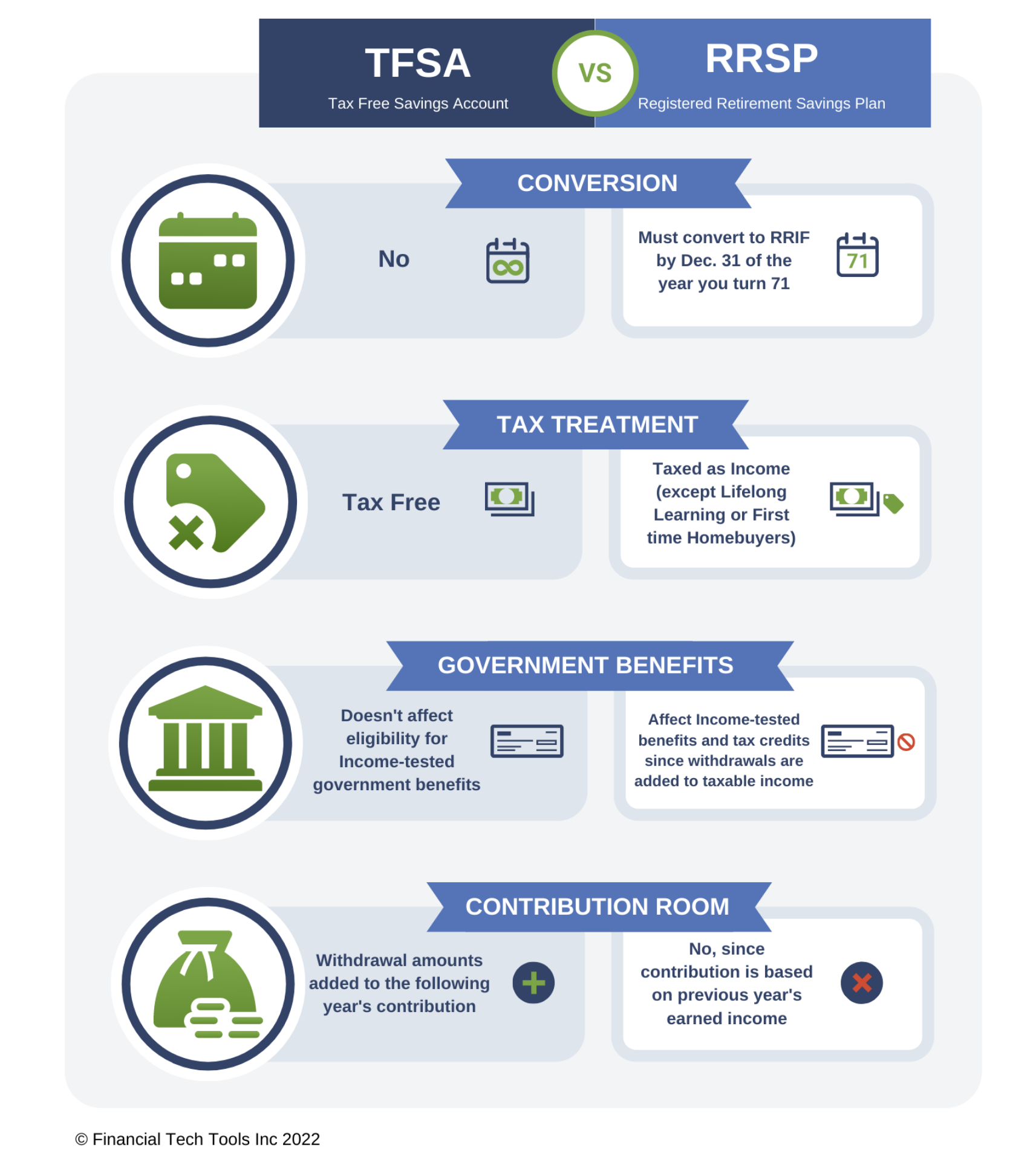
For a TFSA, there are never any conversion requirements as there is no maximum age for account holders.

However, if you have an RRSP, you must convert it to a RRIF by December 31st of the year in which you turn 71.

Tax Treatment of Withdrawals

One of the most attractive things about the TFSA is that all your withdrawals are tax-free! This ability to withdraw funds tax-free is why TFSAs are advantageous for short-term goals; you don’t have to worry about taxes when you take money out to pay for a house or a dream vacation.

With an RRSP, if you make a withdrawal before converting it to a RRIF, it will be taxed as income except in two cases:

  1. The Home Buyers Plan lets you withdraw up to $35,000 tax-free, but you must pay it back within fifteen years.

  2. The Lifelong Learning Plan lets you withdraw up to $20,000 ($10,000 maximum per year) tax-free, but you must pay it back within ten years.

How will my government benefits be impacted?

If you are withdrawing from your TFSA or RRSP, it is essential to know how your withdrawals can impact any benefits you receive from the government.

Since TFSA withdrawals are not considered taxable income, they will not impact your eligibility for income-tested government benefits.

RRSP withdrawals are considered taxable income and can affect the following:

  • Income-tested tax credits such as Canada Child Tax Benefit, the Working Income Tax Benefit, the Goods and Services Tax Credit, and the Age Credit.

  • Government benefits including Old Age Security, Guaranteed Income Supplement and Employment Insurance.

How will a withdrawal impact my contribution room?

If you make a withdrawal from your TFSA, then the amount you withdrew will be added on top of your annual contribution room for the following calendar year. However, if you withdraw money from your RRSP, you do not open up additional contribution room.

The Takeaway

The RRSP and TFSA are both great savings vehicles. Understanding the differences between these two types of tax-advantaged accounts can help you better plan for future purchases and your eventual retirement. Get in touch with us if you would like to learn more about maximizing your savings plan.

Clients, Families

2022 BC Budget Highlights

Image by https://www.bcbudget.gov.bc.ca/2022/

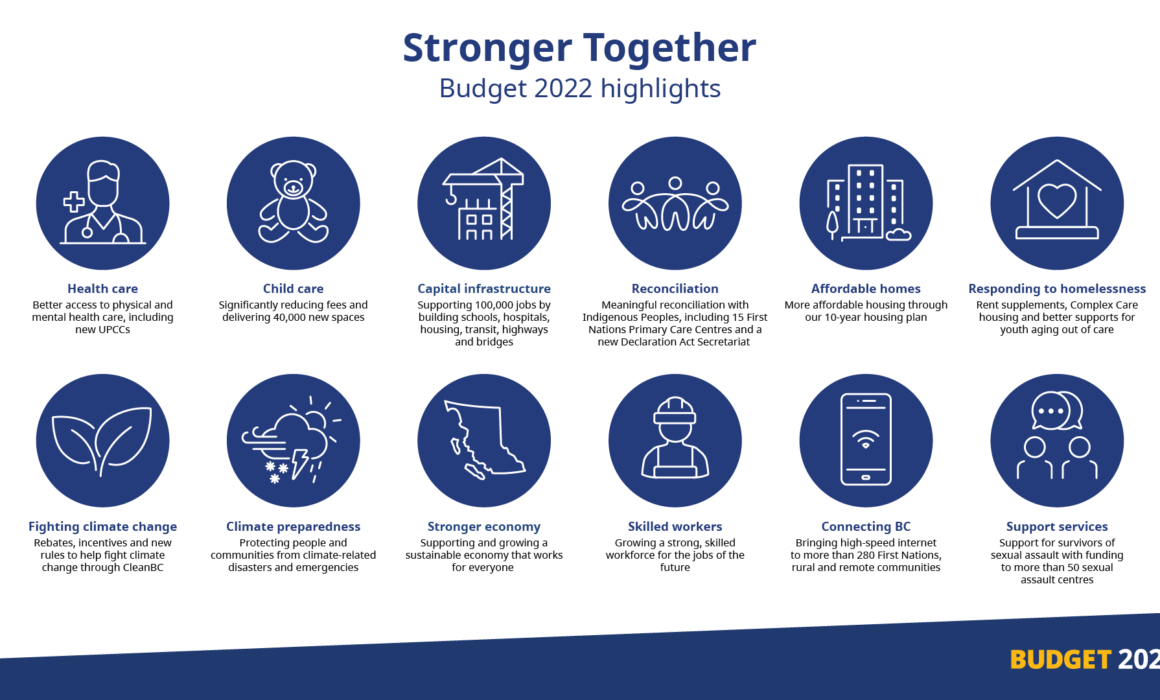
On February 22, 2022, the B.C. Minister of Finance announced the 2022 budget. We have highlighted the items that may be most important to you.


Supporting Sustainable Economic Development

Budget 2022 contains several measures to help build a more robust economy, including $50 million to support growing sectors such as life sciences, manufacturing, and agriculture. In addition, the budget allocates funding to help industries impacted by COVID-19, including the tourism industry, the arts, and non-profit organizations. Finally, Budget 2022 supports workers looking to upgrade their skills or train for new jobs, with an emphasis on providing training for early childhood educators and health care assistants.

Offering Stronger Health Care

Budget 2022 includes funding to support the opening of new urgent and primary care centres and continuing Pathway to Hope from Budget 2021, which dedicated $500 million over two years to support mental health and addiction care. As well, Budget 2022 includes funding for B.C. Centre for Disease Control.

Expanding Child Care Options and Lowering Fees

Working with the federal government, the B.C. government will create 40,000 new licensed child care spaces for children under six over the next seven years. The budget also includes an investment in increasing before– and after–school spaces and expanding the Seamless Day program to include 44 school districts.

Fees for full-day infant and toddler care will be reduced by 50% by the end of 2022 (to an average of $20/day). In addition, average preschool and before– and after–school care fees will be cut to less than $20/day for the 2023-2024 school year.

Supporting Capital Infrastructure

Budget 2022 commits to spending over $27 billion to support critical infrastructure including schools, hospitals, affordable housing, and highways and bridges. This amount of capital spending will support the creation of over 100,000 jobs.

Providing Funding For Affordable Homes

Budget 2022 allocates 2 billion dollars to HousingHub. HousingHub is a program that provides low-interest loans to private developers and other community groups and is designed to give middle-income British Columbians more opportunities to rent or own homes.

Promoting Clean Transportation

Budget 2022 continues to build on the B.C. government’s plan to fight climate change. PST will no longer be charged on used Zero-Emission Vehicles (ZEVs). In addition, the luxury tax threshold on ZEVs has been increased, and rebates will be available for both ZEVs and ZEV charging infrastructure.

No Changes To Corporate or Personal Tax Rates

Budget 2022 does not include any changes to the province’s corporate or personal tax rates.


We can help!

Feel free to reach out to us if you have any questions about how this year’s budget changes will impact your finances.

Financial Planning

2022 Financial Calendar

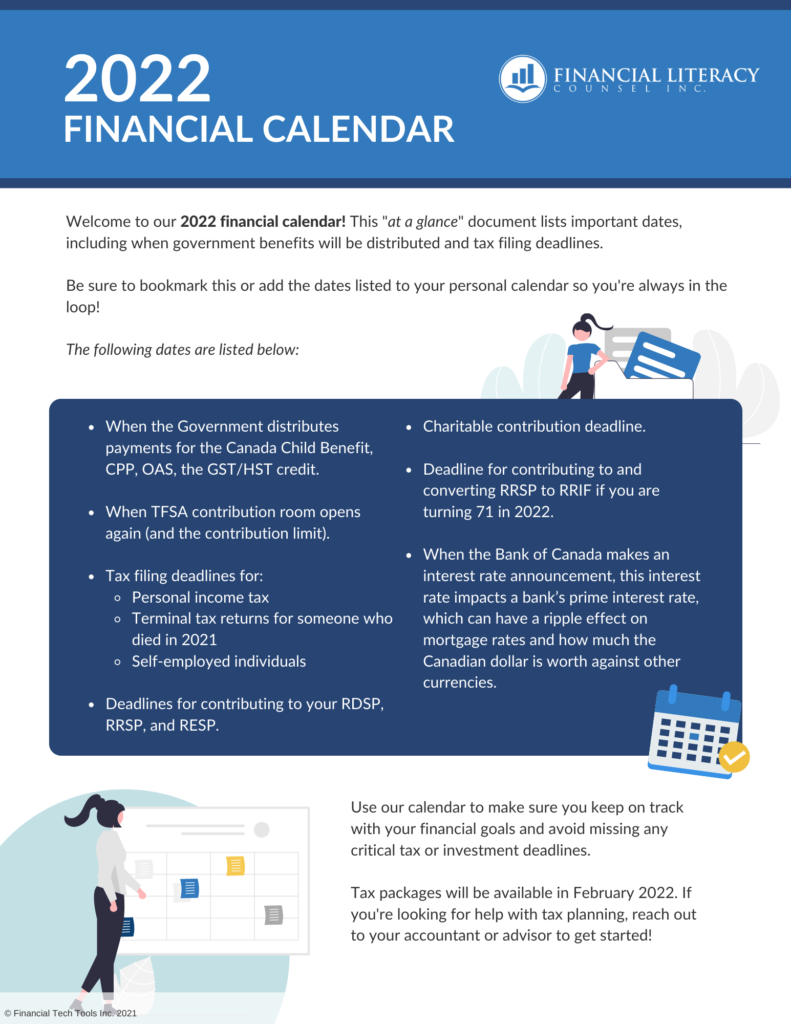
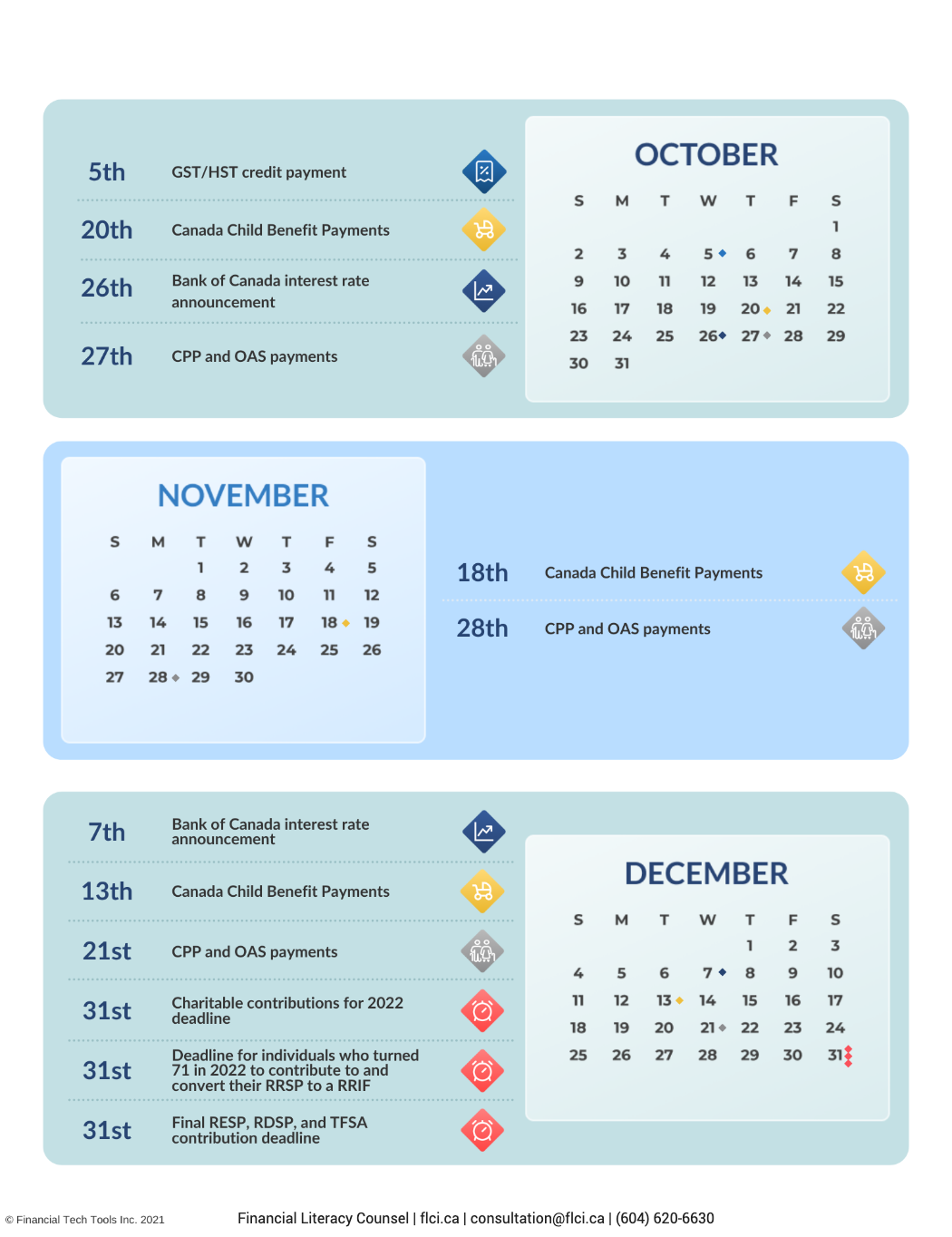
Welcome to our 2022 financial calendar. This “at a glance” document lists important dates including government benefit distribution timeframes and tax filing deadlines.

Be sure to bookmark this page, or add the dates listed to your personal calendar, to stay on track with your financial goals and avoid missing any critical tax or investment deadlines.

If you’re looking for help with tax planning, reach out to your accountant or advisor to get started!

Important Dates

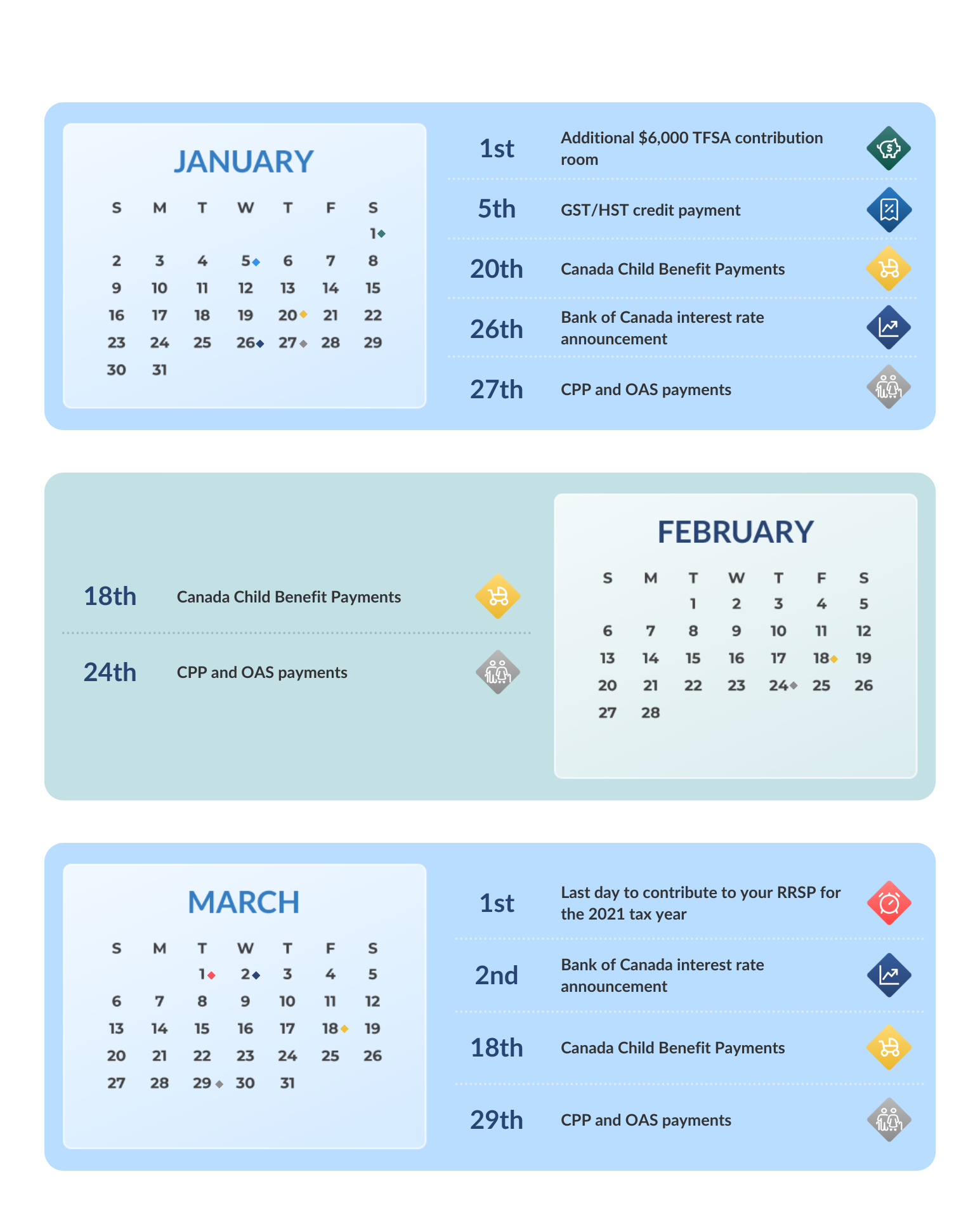
  • January 1 is when the contribution room for your TFSA opens again. The maximum contribution for 2022 is $6,000.

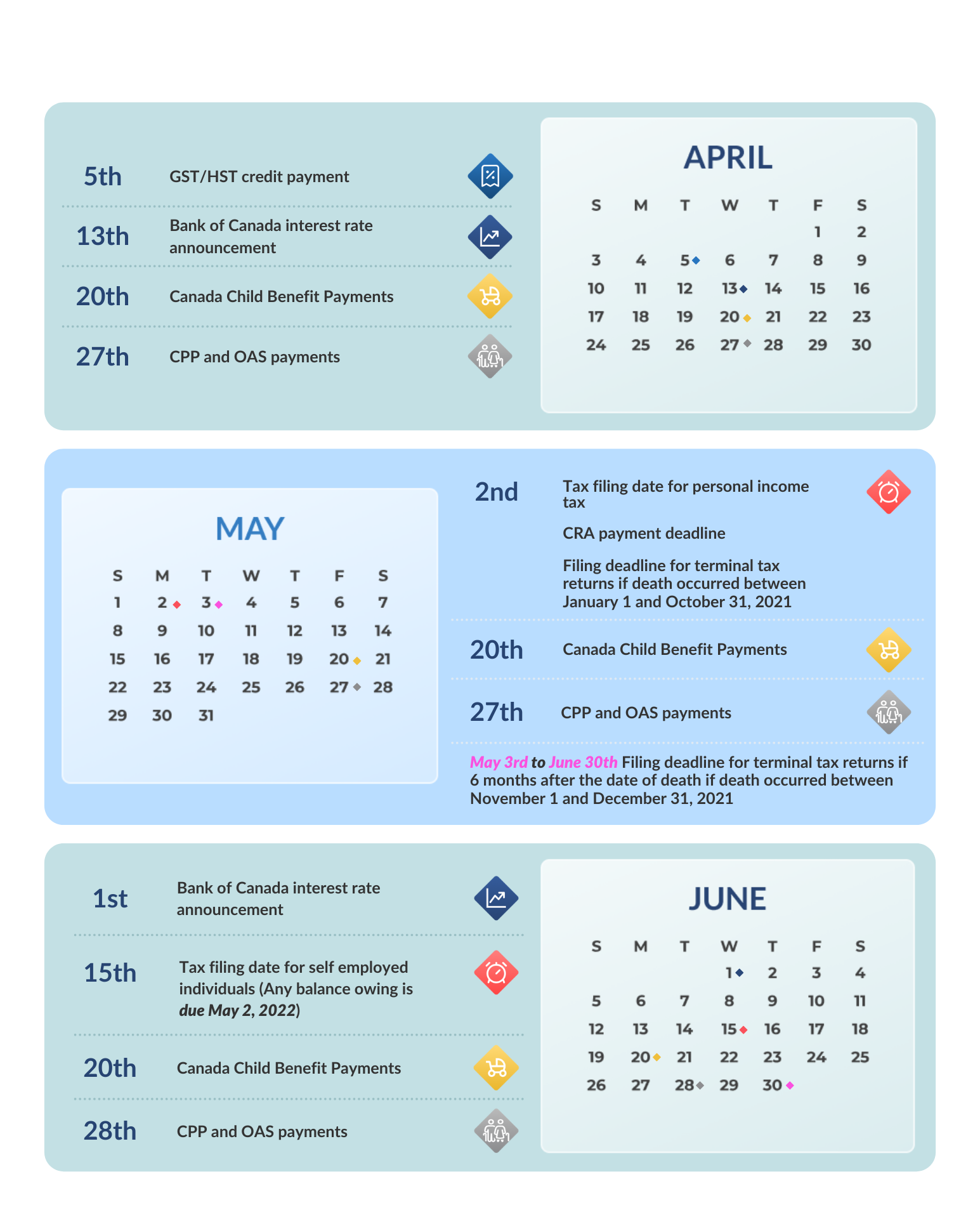
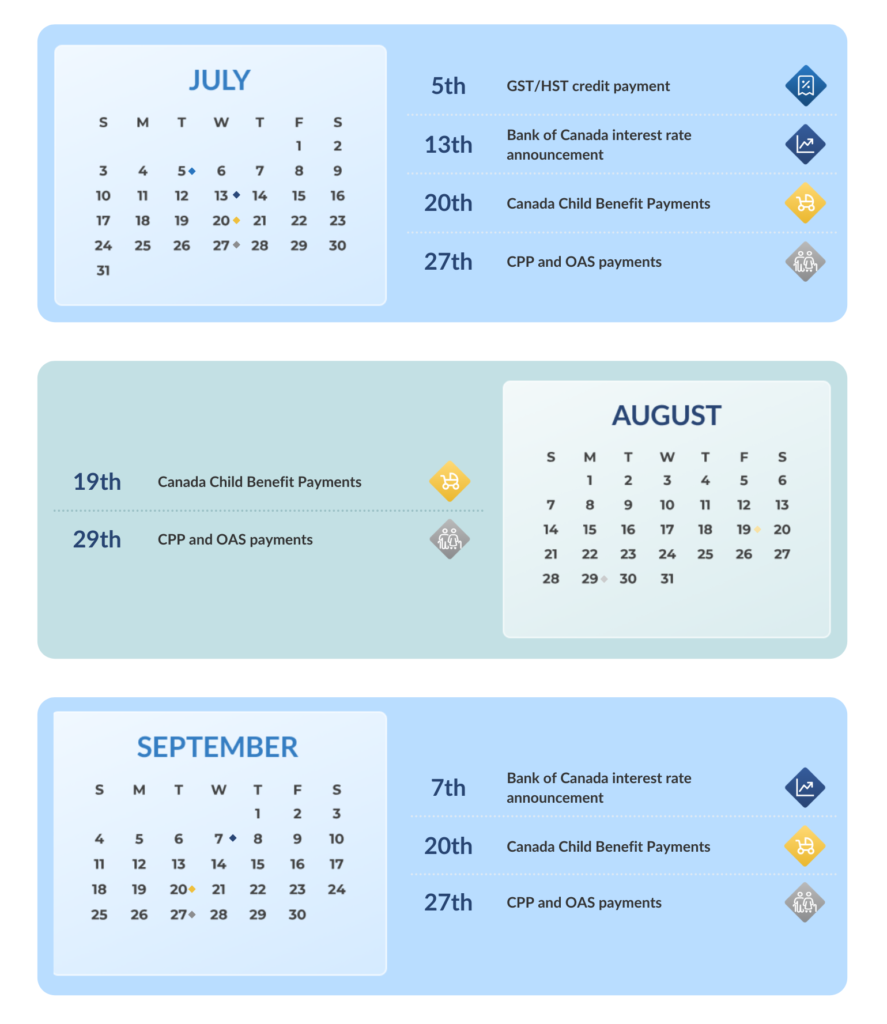
  • The government will issue GST/HST credit payments on January 5, April 5, July 5, and October 5.

  • Canada Child Benefit payments (CCB) will be issued on the following dates: January 20, February 18, March 18, April 20, May 20, June 20, July 20, August 19, September 20, October 20, November 18, and December 13.

  • The government will issue CPP and OAS payments on the following dates: January 27, February 24, March 29, April 27, May 27, June 28, July 27, August 29, September 27, October 27, November 28, and December 21.

  • The final date for your RRSP contributions to be eligible for the 2021 tax year is March 1, 2022.

  • Bank of Canada’s interest rate announcements will be on January 26, March 2, April 13, June 1, July 13, September 7, October 26, and December 7.

  • May 2, 2022 is the last day to file personal income taxes and tax payments are also due by this date. This day is also the filing deadline for final returns if death occurred between January 1 and October 31, 2021.

  • From May 3 to June 30 is the filing deadline for final tax returns if death occurred between November 1 and December 31. The due date for the final return is six months after the date of death.

  • The tax deadline for all self-employment returns is June 15, 2022. Any balance owing, however, is due May 2, 2022.

  • The deadline for final RESP, RDSP, and TFSA contributions is December 31.

  • December 31 is also the deadline for 2022 charitable contributions.

  • Additionally, December 31 is the deadline for individuals who turned 71 in 2022 to finish contributing to their RRSPs and convert them into RRIFs.

1 2
Privacy Settings
We use cookies to enhance your experience while using our website. If you are using our Services via a browser you can restrict, block or remove cookies through your web browser settings. We also use content and scripts from third parties that may use tracking technologies. You can selectively provide your consent below to allow such third party embeds. For complete information about the cookies we use, data we collect and how we process them, please check our Privacy Policy
Youtube
Consent to display content from - Youtube
Vimeo
Consent to display content from - Vimeo
Google Maps
Consent to display content from - Google
Spotify
Consent to display content from - Spotify
Sound Cloud
Consent to display content from - Sound
BOOK AN APPOINTMENT